Tag Archives: children

Today I am celebrating Food Day with…an apple!

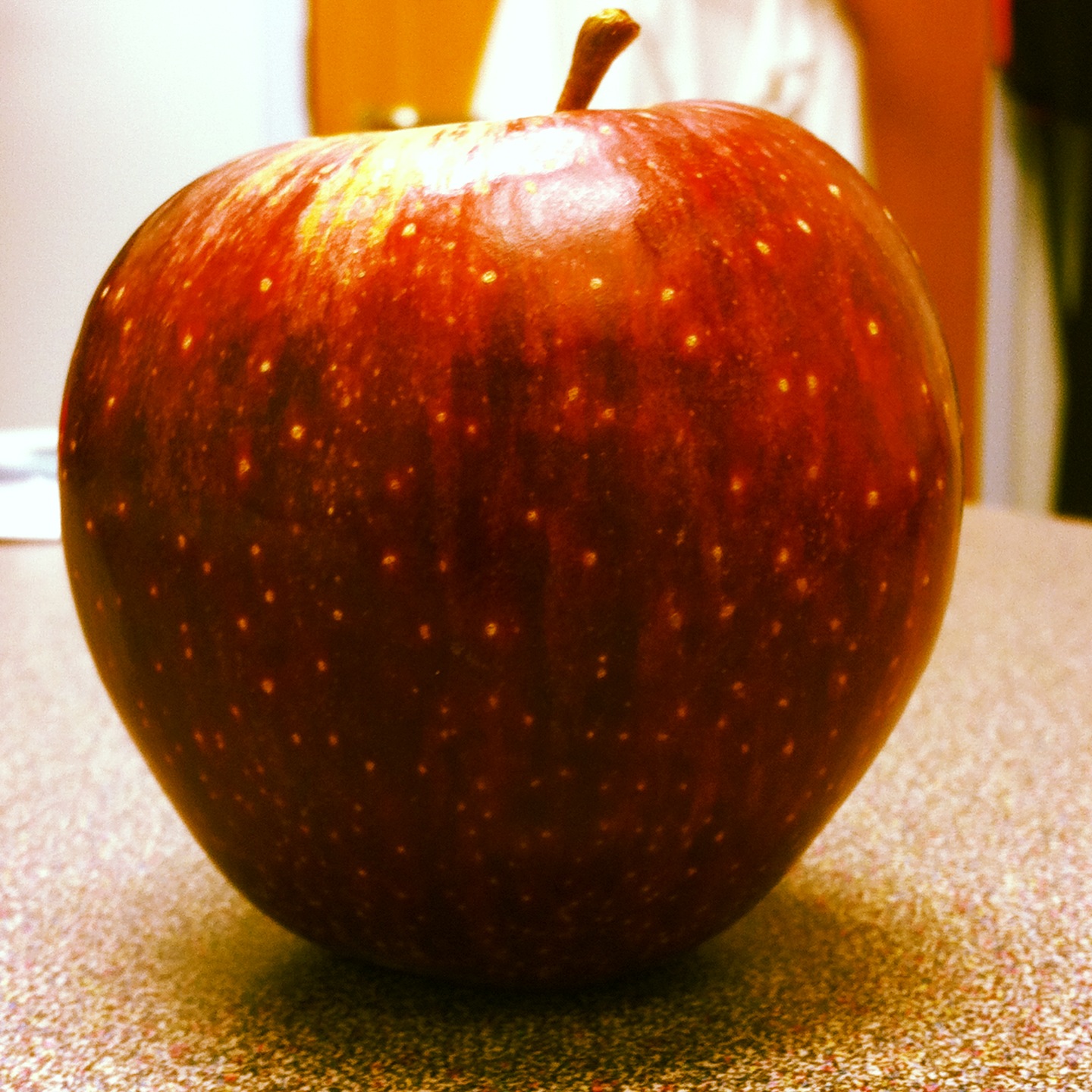
Specifically, this apple.

2013-10-24 15.59.46
This past weekend my family was visiting the upstate and we took the kids to pick apples at Bryson’s Apple Orchard. Not only did we get a bunch of delicious apples, but the kids got to learn a little about where apples come from. As kids tend to do, they ate as they picked, and noticed immediately that the fresh-picked apples were much tastier than the ones from the grocery store. They even got to meet “Farmer Bryson,” who appreciated our business and the kids’ enthusiasm.
And this is the point of Food Day: learning where food comes from, eating fresh foods, and supporting local farmers. I tried to explain this to my kids while we were driving home from the farm, but they were more interested in eating the apples they had just picked!


Just in time for Childhood Obesity Awareness Month: The completely unauthorized and ill-advised childhood obesity experiment

September is Childhood Obesity Awareness Month, which is the topic of my Health & Fitness column in the Aiken Standard today.

Although the causes involve a complex interaction of genetic, biological, behavioral, and environmental factors (as this article explains), most cases likely involve too little activity and too much energy intake, particularly added sugars. It is important to note that both diet and activity play a role, and both a targets for prevention and treatment. The same is true for adults, too.

Obesity among children, both young kids and teenagers, is associated with serious health, social, and psychological problems. In fact, obese children, especially those who are inactive, tend to develop “adult” diseases including high blood pressure and diabetes.

And while we know that obesity and inactivity in kids is a problem, I don’t think we realize how bad it is now or will be in the future. That’s because no one has any idea what will happen to an obese 12-year old who develops type 2 diabetes. Adults who become diabetic are at higher risk for an early heart attack; does this mean that a 12-year old will be on the fast track  toward a heart attack at age 30?

We don’t know. But I think we are going to find out. Unfortunately, it’s as though we are experimenting with a generation of children to find out.


What kids will be missing when they go back to school.

My Health & Fitness column in the Aiken Standard this week is about the experience of heading back to school. But it’s really about what most kids won’t experience when they are in school—any meaningful education about nutrition, activity, and health.

To be sure, the time that students spend learning the math and science, reading and writing, and art and music is time well spent. Unfortunately, though, in most schools, this comes at the expense of health education. In fact, opportunities for children to be active in school, either through formal physical education or more informal play and recess, has declined over the years. Good nutrition isn’t likely to get much classroom time at any level and the food served in most school hardly sends a positive message about healthy eating. These are missed opportunities!

This isn’t new, of course. I have written about the both the importance of physical activity for growth and learning for children (and adults, too) and the impact of these missed opportunities before. And I’m certainly not the only one to take notice. Probably the most widely known advocate in this area is Jamie Oliver, and his efforts made nutrition and health in schools topics for discussion among parents, teachers, administrators, and politicians alike.

My son, the Michigan State Police, and healthy choices at McDonald’s

Earlier this evening my family went for a bike ride. That’s when my son got pulled over by the Michigan State Police and was given a ticket!

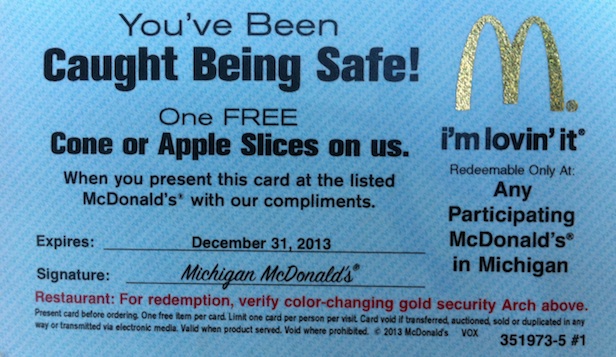
He was pulled over for being safe by wearing a helmet and the “ticket” was a card for a free ice cream cone at McDonald’s.

It is part of a program that rewards kids for being safe and wearing a helmet when they ride a bike. Since we were all wearing helmets, my oldest son (and his two younger brothers) got “tickets” from the police officer.

It was when we got home and I looked at the card more closely that I noticed something nice—the card is good for either a free ice cream cone OR apple slices.

icecream_or_apples Bike_helmet

I’m sure almost all kids will pick the cone (I know my kids will!), but it’s nice to have a healthy option.

It’s not just for kids: Adults need recess, too.

The childhood obesity epidemic is usually blamed, in part, on the fact that most kids aren’t active enough at home and at school. Opportunities for activity in school are less common now because programs like physical education and recess are being cut in an effort to save money or to dedicate time for test preparation. This has an effect not only on health but on academic performance, since regular activity improves attention, memory, and learning (in addition to the health benefits).

Parents are partly to blame, too. There are plenty of missed opportunities for physical activity outside of school. Since most adults don’t get enough activity, it is no surprise that they aren’t encouraging their kids to be active.

Adults get the same benefits from regular physical activity as children do. Just as kids who are active during the  day perform better at school, adults who are active at work are more productive. But most people spend much of their work day sitting with little to no activity. This is bad for health and for job performance.

So why don’t adults get recess, too? They should!

This is the topic of my Health & Fitness column in the Aiken Standard this week. It is also the mission behind an initiative called Instant Recess, which provides tools to help people include short activity breaks into their day. Far from being a burden or a waste of time, these short bouts of activity improve health, mental wellbeing, and productivity.

Missed opportunities to promote physical activity for kids.

Most kids don’t get enough physical activity. No surprise that inactivity is associated with health conditions like obesity, high blood pressure, and diabetes. But a lack of activity in children can lead to poor academic performance, too.

But we are missing good opportunities to provide kids with chances to be physically active at home and in school. This is the topic of my Health & Fitness column in the Aiken Standard today.

Schools are a perfect place to include opportunities to be active. Unfortunately, opportunities for activity, from PE to recess, are among the first cuts to be made when budgets are tight. Why isn’t promoting an active, healthy lifestyle  just as important as promoting math or reading or science?

A common argument is that parents should teach their children about a healthy lifestyle, not schools. I disagree. At some point, we (society) decided that parents shouldn’t have to teach their kids math or reading or science. I don’t know the exact rationale, but it likely had something to do with the fact that most parents don’t have the knowledge or skills to teach these essential subjects. Why should activity and, while we are at it, nutrition, be any different?

In fact, we have been experimenting with removing  physical activity and nutrition education from schools and leaving it to parents for some time now. Given the childhood (and adult) obesity epidemic, it hasn’t gone well. Maybe it is time to revisit providing quality health, activity, and nutrition education in schools.

If you want to learn more about benefits of and ways to promote physical activity for kids the Physical Guidelines for Americans is a good place to start. In particular, the Midcourse Report offers recommendations and solutions regarding physical activity in children.

News from CSPI: 97% of Kids’ Meals Flunk Nutrition at Chain Restaurants

I just read this today but it is from about a month ago, so you may have seen it already.

97% of Kids’ Meals Flunk Nutrition, as Fried Chicken Fingers, Burgers, Fries, Soda Dominate at Chain Restaurants ~ Newsroom ~ News from CSPI ~ Center for Science in the Public Interest.

Recently I  wrote about how popular children’s breakfast foods—cereal, Pop-Tarts, and “juice” drinks—more closely resemble candy and soda than a healthy meal to start the day.

When it comes to eating at many restaurants it appears that most kid’s meals more closely resemble an unhealthy adult meal than a healthy lunch or dinner appropriate for a child.

While we (parents) are responsible for making healthy choices for our kids, it is challenging given the general lack of good options. There are exceptions, of course, including the Fresh Fit for Kid’s meals at Subway that were mentioned in the CSPI article and healthy kid’s meals at EarthFare.

Candy and soda for breakfast! The truth about popular children’s breakfast foods.

Breakfast is the most important meal of the day, right? A healthy breakfast can help kids pay attention and do better in school. In adults, a good breakfast can reduce hunger and help with weight control. That’s probably not new.

You may be surprised to learn that many  popular breakfast foods for children—and adults—are anything but healthy. In fact, many of these choices more closely resemble candy and soda than a healthy start to the day!

This is the topic of my Health & Fitness column in the Aiken Standard this week. It was also a project that one of my students, Brittney Austin, worked on this semester. While some of the results clearly showed that some breakfast foods were essentially candy, like frosted Pop-Tarts which have nearly as many calories and as much sugar as a Reese’s Peanut Butter Cup.

In other cases, the comparison is more complicated. For example, Sunny D orange drink contains only 5% juice but has as much added sugar as a Coke. It is essentially orange soda without the bubbles. But when you consider that 100% orange juice has as much sugar as the Sunny D, maybe the “orange soda without bubbles”  isn’t so bad.

But it is! While it is true that the sugar content is essentially the same, the real orange juice also contains vitamins and minerals. And  even though some “juice” drinks have added vitamins and minerals, the real juice is still better. Here’s why: children who drink the artificially sweetened juice flavored drinks may become accustomed to the unnaturally sweet taste and find that they don’t like naturally sweetened juice or whole fruit. So even if the nutrients are the same as real juice, the “juice” drinks can lead kids away from eating fruit—a bad outcome!

Take a close look at what your children eat for breakfast. Is it a healthy meal or candy and soda in disguise? And take a good look at your own breakfast. It may not be much better!

A fitness test kids can actually pass

There is something to be said for creating a fitness assessment for children that most kids can actually pass. Maybe the solution to the poor fitness of America’s children is to change our definition of fitness.

Presidential Fitness Test Now Awarded To Any Kid Who Can Eat Without Sweating | The Onion – America’s Finest News Source.