Tag Archives: healthy-living

Stealthy Healthy Eating

My Health & Fitness column in the Aiken Standard this week is about the many processed foods that include added nutrients, primarily vitamins, minerals, and fiber, to make them healthier. While this seems like a good thing—helping people get enough essential nutrients, even if they eat a poor diet—there are drawbacks to using these foods instead of eating actual food that contains these nutrients.


What if there was a way to get the benefits of eating vegetables without having to eat any vegetables? This may be a dream for millions of American children and adults who don’t eat enough vegetables.

Thanks to creative food processing, the healthy components of vegetables can be added to many foods, including soda, candy bars, and other sweets. Books and websites contain recipes for adding pureed vegetables to brownies and other baked goods. There is even a new line of prepackaged pureed vegetables to use!

The recommended intake of vegetables ranges from one cup per day for young children to 3 cups for adults. A simpler guideline is to fill half of your plate with fruits and vegetables at each meal. The goal should be to eat a variety of vegetables throughout the week.

There are plenty of good reasons for people to eat vegetables. Most vegetables are a low-calorie source of essential vitamins and minerals. The dietary fiber found in vegetables (and fruits and whole grains) plays a role in maintaining a healthy body weight, lowering cholesterol, and reducing the risk of some cancers.

Fiber is increasingly added to processed foods including granola bars and energy bars. It is possible to get up to half of your daily recommended intake of fiber by eating a single Fiber One bar. That is the equivalent of a cup or more of most vegetables! Considering that many of these snacks are essentially candy bars, they are a tasty way to get fiber.

Vitamins and minerals have long been available as supplements and added to certain foods, including products made from grains like pasta and bread. But now you can get vitamins in many soft drinks, many of which have as much sugar as soda. And calcium is added to a variety of foods from breakfast cereals to snacks.

There are, of course, some benefits of doing this. People who don’t eat a healthy diet can get enough essential nutrients through these products. Some of these foods are low in calories so they can help people who are trying to lose weight.

While these “hidden” nutrients may seem like a good solution for people who don’t eat enough vegetables, this form of stealthy healthy eating may have some negative consequences.

These processed foods may be high in sugar, fat, and calories which could contribute to weight gain. The fact that these foods are designed to taste good—many include chocolate—may lead people to overeat. Aside from excess calories, eating far too much fiber could cause GI discomfort or other health problems.

More concerning, though, is the fact that these foods set an expectation that healthy foods should be sweet. This is particularly problematic in children, who may avoid eating vegetables (and other healthy foods) in favor of sweet drinks and snacks that contain the same nutrients.

Additionally, getting vitamins, minerals, and fiber through processed foods keeps people from learning how to make healthy choices and prepare real food. This has consequences for developing healthy eating habits in both children and adults.

Focusing on getting individual nutrients over eating a variety of healthy foods is thought to be an important cause of the current obesity epidemic. Relying on processed foods with added vitamins, minerals, and fiber may be doing more harm than good to your health.

The bottom line is that you should get your nutrients from real food and balance what you eat with daily physical activity. Remember, good health comes from making smart choices, not from a bottle or a box!
How to win at losing: What to do when your diet ends.

In the past few weeks several community and fitness center-based weight loss programs have ended. Since many diets and exercise programs last 12–15 weeks, this time of year marks the end of many programs. During this time many people have met personal weight loss goals through individual diets and “biggest loser” type programs. (I have written about competition-type weight loss programs in the past here and elsewhere.)

One of these is the Team Lean program at the Y. This year over 1,600 people from the Aiken and Augusta area participated in this 12-week program that included weekly education sessions and weigh-ins, a strong group dynamic, and monitoring to prevent rapid, unhealthy weight loss. The average participant lost almost 10% of their body weight, which is sufficient to promote improvements in blood pressure, cholesterol, and diabetes.

This level of weight loss is common among people who participate in individual or group programs. But the real challenge is to maintain that weight loss after the program ends. Many people have successfully met their weight loss goal only to gain the weight back later. In fact, some people do it every year, losing and regaining the same 10 (or 20 or 30) pounds over and over.

Losing weight is challenging, to be sure. But maintaining weight loss can be even more challenging. Many people think that they are finished once their diet or weight loss program ends. The truth is that the end of the diet marks the beginning of the next phase: keeping the weight off. This is the topic of my Health & Fitness column in the Aiken Standard this week.

There is a practical reason why this happens. In order to lose weight and keep it off people need to learn a whole new lifestyle involving what, when, why, and how they eat as well as daily exercise. These lifestyle changes are difficult to make and can take months or years to fully adopt. In many cases, the weight loss program ends before people make lasting behavior changes and revert to their old habits.

While there are literally hundreds of diets and weight loss programs to choose from, “weight maintenance” programs are far less common. The good news is that following the advice of people who are successful at losing weight and keeping it off can help you maintain your weight loss.

The National Weight Control Registry (NWCR) is a collection of information submitted by individuals who have succeeded at long-term weight loss. These “successful losers” have lost an average of 66 pounds and kept it off for over five years, with some losing as much as 300 pounds! Best of all, they share the secrets of their success.

It turns out that they lost weight through a variety of diets and programs. Nearly half lost weight on their own and the other the other half followed of some type of program. Regardless, almost all of them increased their physical activity and modified their diet, suggesting that diet and exercise together are important for successful weight loss.

There is also variety in how NWCR members keep the weight off. Most report continuing to maintain a low-calorie, low-fat diet and doing high levels of activity. Almost 80% eat breakfast every day, 75% weigh themselves at least once a week, over 60% watch less than 10 hours of TV per week, and 90% exercise, on average, about 1 hour per day.

Many people worry whether they are following the “best” diet or weight loss program. The specific diet may not be as important as what you do when it ends. Notice that the majority of successful losers still control what they eat and nearly all exercise each day. This suggests that going back to the way you ate before you lost weight is unrealistic. And if you aren’t exercising, at least walking, every day already, now is a good time to start.

Go outside and play!

If you are like most people, you have probably spent much of the day indoors, probably sitting. In fact, this is likely how you spend most days. According to one survey, the average American may spend up to 15 hours per day sitting at work or at home. If you subtract sleeping, this accounts for nearly the entire day!

Prolonged sitting has been linked to negative health effects that are similar to those of not exercising. Even among people who do exercise, those who spend more time sitting tend to have more health problems than those who are more active during the day. Consider yourself lucky if you have a job that keeps you active.

The good news is that you can offset the health effects of sitting too much. Taking short breaks at work can improve attention and productivity. In fact, many time management and productivity techniques include periods of focused work separated by breaks. Using these breaks to get up and move is good for your body and your mind. The same is true at home—getting off the couch during TV commercials can have the same benefits.

Even greater benefits can be gained from dedicating more time to be active, especially regular exercise. A lower risk of weight gain, diabetes, heart disease, and some cancers are among a long list of positive health effects of physical activity. Lesser known benefits include improved mental health, cognitive function, and greater feelings of wellbeing.

Being active in a natural environment seems to have an even bigger impact on mental health. This is the topic of my Health & Fitness column in the Aiken Standard this week.

Indeed, activity outdoors leads to enhanced feelings of energy and diminished fatigue, anxiety, anger, and sadness compared to similar activity conducted indoors. Additionally, some research suggests that outdoor activity may improve attention in adults and children.

Another advantage of exercising outdoors is that you might get a better workout. This is mostly due to the fact that you will likely walk or run faster outdoors, but other factors like wind resistance add to your effort. Research shows that even though people tend to exercise at a higher intensity outside, they don’t necessarily feel it. In fact, ratings of effort are lower outdoors for the same exercise.

This because the pleasant visual stimuli outdoors distracts you from unpleasant sensations of effort during exercise. This is the same reason that listening to music makes exercise more enjoyable and why fitness centers have televisions on the walls or built into exercise equipment. Think of the outdoors as a really big TV screen!

Almost any indoor exercise can be moved outdoors. While walking, running, and cycling are most obvious, resistance training exercises using body weight and many high-intensity interval training workouts can be modified for outdoors. Yoga and aerobics classes in the park are also great ways to promote both the physical and psychological benefits of exercise.

Much of the psychological benefit of outdoor exercise occurs in the first five minutes, so even short bouts of activity are meaningful. It also means that going for a short walk outside when you have a break at work or walking instead of driving short distances can have positive effects. At home, taking the dog for a walk, playing outside with the kids, or doing yard work are good ways to be active and reap the benefits of being outdoors.

Every little bit of activity you do outdoors will have both physical and psychological benefits to help you become and feel healthier. So, go outside and play!

Physical activity at school in two infographics

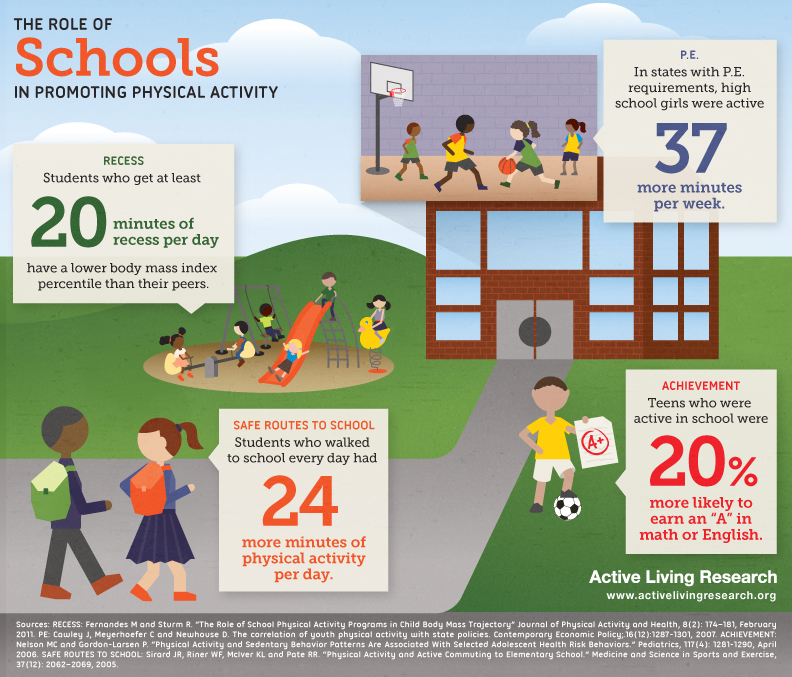
This week I came across two infographics explaining the benefits of including physical activity in the school day and ways kids can be active at school.

Having opportunities to be active throughout the day benefits children in many ways, from improving their health, helping them maintain a healthy weight, and promoting learning. In fact, physical activity through recess, structured PE class, and other unstructured activities is absent at many schools. This represents a missed opportunity to teach children about the importance of being active.

According to these infographics, though, engineering activity into the school doesn’t have to be difficult. And including physical activity in the school day makes children believe it is important (which it is) and helps develop habits that will last into adulthood.

alr_schools

The Role of Schools in Promoting Physical Activity | via Active Living Research


Screen Shot 2014-03-06 at 8.14.35 PM

Get 60 Minutes | via Institute of Medicine


Now if we could just do something about the quality of school lunches!

Reducing your risk of heart disease

February is Heart Month, an ideal time to assess your risk of heart disease and take steps to improve your health. This is important because heart disease, sometimes called coronary artery disease, is the leading cause of death among adults in the United States. It is responsible for nearly 600,000 deaths each year, mostly from heart attacks. Millions more are at increased risk because of certain biological and behavioral risk factors.

Identifying your personal risk for heart disease and making efforts to improve your heart health is the topic of my Health & Fitness column in the Aiken Standard this week.

Some of these risk factors cannot be changed, such as age, sex, and family history, while others can be altered to reduce risk. These modifiable risk factors include smoking, high blood pressure, high cholesterol, diabetes, obesity, and physical inactivity. While your doctor can play an important role in treating these conditions, there is much you can do on your own to improve your heart health.

The first step is to get a good assessment of your heart health. If you haven’t done so recently, you should see your doctor to have your risk factors evaluated. This includes tests for blood glucose and blood lipids (including total, LDL, and HDL cholesterol and triglycerides), measurement of your blood pressure and body weight, and an assessment of other health factors such as your family history, whether you smoke, and your level of physical activity.

The next step is to treat the risk factors that you have. Depending on the severity and your own personal health history your doctor may prescribe medications to lower your blood pressure, blood glucose, or blood lipids. These medications are most effective when combined with lifestyle changes including good nutrition, exercise, and weight loss. In some cases, poor diet and lack of activity can counteract the beneficial effects of these drugs. Furthermore, these healthy habits may help you reduce the dosage, and limiting the side effects, or stop taking the medications altogether.

The other risk factors—obesity, inactivity, and smoking—really must be treated through lifestyle management. While there are medications that can help with smoking cessation and weight loss, being successful requires making lasting behavior changes. These habits can be difficult to change, and many people have tried before without success. Keep in mind, though, that everyone who is successful at quitting smoking, losing weight, or sticking to an exercise program has experienced his or her share of difficulty. The difference is that those people kept trying until they were successful. You can be successful, too.

Even small changes can have a big impact. Take exercise, for example. The benefits of as little as 30 minutes of physical activity per day are well established and impact heart disease risk in a multitude of ways. Physical activity helps with weight control, lowers blood pressure, improves blood lipids, and prevents and treats diabetes. Think of this as a great health “deal.” By modifying one risk factor—inactivity—you can also promote beneficial changes in four others—obesity, hypertension, high cholesterol, and diabetes. There is no other treatment, drugs included, which can have such a broad impact on reducing heart disease risk!

Of course, there are steps you can take beyond becoming more physically active to reduce your risk of heart disease. The list of beneficial changes you can make to improve your heart health is long, but keep in mind that even small changes can add up to a big benefit. 

Knowing which risk factors are most concerning can help you and your doctor make effective treatment decisions. Quitting smoking, increasing your physical activity (and reducing sedentary time), and eating a healthier diet can lead to improvements in heart disease risk factors and reduced heart attack risk. The best news is that these same changes can also reduce your risk of other serious health problems including many types of cancer, stroke, and lung disease.


Eat smart, move more, chill out

The goal of being “more healthy” is a good one, but can include an almost endless list dietary, activity, and other behavioral changes. Some people may feel overwhelmed and unsure of where to begin. Furthermore, there is a perception that you have to implement all of the changes simultaneously or follow a complicated diet or exercise program in order to see results.

But it doesn’t need to be this way. My Health & Fitness column in the Aiken Standard this week outlines a few simple guidelines that have the potential to lead to significant improvements in health, fitness, and wellbeing. Not only are these things you can implement right now, but they are scalable, so the more you do, the bigger the benefits.

1. Eat smart.Healthy eating isn’t necessarily about eating less or avoiding certain foods, it’s about making smart choices when you shop, cook, or eat out. Many problems with the typical American diet probably have to do with the fact that we tend to eat heavily processed, calorie-dense foods. The major difference between what we eat now and what most people ate before the current obesity epidemic is the processing our food undergoes.

You can eat smart by focusing on eating real food—fresh and minimally processed plants and animals—instead of the processed and pre-packaged food that is so common in restaurants and in meals we eat at home. That isn’t to say that all processed food is necessarily unhealthy, but it would be wise to shift the balance toward more real food.

This isn’t necessarily new advice…it was featured on the cover of a popular book in 2009, after all. But this message seems to have gotten lost in the chaos of health claims made by manufacturers in advertisements and on food labels.

You can do this right now by having a piece of fresh fruit, some nuts, or vegetables for a snack. Later, you can make most of your food purchases from the perimeter of the grocery store, and less from the aisles in the middle.

2. Move more. Most people spend too much time sitting and not enough time moving. In fact, the amount of time someone sits during the day has nearly as much impact on their health as their exercise habits. So, step one is to sit less.

Next, move more, which means just that—finding ways to be active during the day. This includes simple things like standing rather than sitting when you talk on the phone, taking the stairs instead of the elevator, and getting up off the couch during commercials. It also includes dedicating time every day for structured exercise or other activity like yard work, house work, or taking the dog for a walk. Every little bit helps, but aim for a minimum of 30 minutes per day.

Right now you are probably sitting, so stand up and stretch or move around a little. Later, go for a walk or do something active around your house.

3. Chill Out. With so much emphasis placed on diet and exercise, the health effects of stress are often overlooked. Chronic stress can have serious emotional, psychological, and physiological effects that lead to or exacerbate many health problems. While it is impossible to avoid all stress in life, minimizing stressors and managing the way you respond to stress can have important benefits.

Exercise is one good way to manage your feelings of stress as well as the effects it has on your body. Yoga has long been recommended to help reduce and control stress, but all types of exercise can help. Managing time better, including getting enough sleep, is helpful for many people.

Right now you can close your eyes and take a few deep breaths to relax. Later, spend some time doing something you enjoy.

So, if you are feeling overwhelmed by complicated and confusing health recommendations, keep it simple: eat smart, move more, and chill out!

Just in time–New Year’s resolutions that will actually help you achieve your goals.

There are just a few more hours until you have to get started on your New Year’s resolutions.

There are also a few more hours to make New Year’s resolutions, if you are a procrastinator.

The most common resolutions are changes to improve health, including quitting smoking, losing weight, and starting an exercise program. Many people who make these–and other–resolutions get off to a good start, but most will end up failing to meet their goals.

While there are many reasons why people don’t keep their resolutions, part of the problem might be that these should not be the only New Year’s resolutions you make. Resolutions should be the things you need to do to achieve your goals, not the goal itself. Here is an example:

Losing 20 pounds is a good goal for many people. But what that really means is learning about a healthy way to eat, shopping for and preparing appropriate meals, finding time to exercise each day, and focusing on turning these behaviors into lasting habits. In this example, learning how to shop for and prepare healthy meals would make an excellent resolution that would lead toward the goal of losing 20 pounds.

The idea of making resolutions that are steps in the process leading toward a goal instead of the goal itself is the topic of my Health & Fitness column in the Aiken Standard this week. Here are a few resolutions that can help you achieve your health improvement goals, whatever they may be:

Be realistic
Many people fail to keep their New Year’s resolutions simply because they don’t set realistic goals or aren’t realistic about what it will take to meet those goals. For example, running a marathon is an ambitious goal for almost everyone, especially someone who doesn’t exercise at all. It is possible that someone could get in shape to run a marathon, but it will take a long time. A resolution to work up to jogging five days per week, with a goal of completing a 10 k run is more realistic and achievable.

Focus on learning
Making most health behavior changes involve learning as much as doing. Something as simple as eating a healthier meals requires learning about the nutrients that make some foods healthier than others, learning to read food labels to select healthy foods, and learning how to cook and prepare healthy meals. If your resolution is to learn about healthy meals you will be able to achieve that goal and be well on your way to eating a healthier diet.

Manage your time
Most health improvement projects require taking time to learn about, implement, and maintain those healthy behaviors. A major reason the people fail to really get started with or sustain a weight loss or exercise program is time. If you resolve to manage your time to include exercise or meal preparation in your daily schedule you will be much more likely to meet your goals. Trying to add these new activities as “extras” to your already busy day will inevitably lead to them getting squeezed out.

Plan ahead
Most people already know that changing health behaviors can be challenging, even under the best circumstances. It’s no wonder that holidays, travel, and other life events can complicate or even derail an otherwise successful diet or exercise program. Make it your resolution to think about what you can do before, during, and after these (and other) disruptions to your routine to keep yourself on track. Planning ahead and thinking “what if” can make the difference between giving up and catching up on your diet or exercise program after a vacation.

Have a happy and healthy New Year!

The Health & Fitness holiday gift guide.

If you haven’t finished your holiday shopping yet, you are not alone. As of last week, the average shopper still has half of their gift buying left to do. The good news is that there is still time to pick out perfect gifts for your friends and family, including gifts that will help them meet their health and fitness New Year’s resolutions.

There are many good gifts that can help people get started on their exercise or weight loss programs. Gift guides including gadgets, apps, clothing, and other gear, like this one from Greatist.com. Many of these tools would no doubt be useful for getting people motivated, providing feedback, and even some healthy competition through social networking.

But these are not the things that people really need to begin and be successful making diet and activity changes. After all, no one ever quit an exercise program or failed at losing weight because they didn’t have the right nutrition app or the latest activity tracker. The real reason people struggle is because of factors like time and support from family and friends in the real, not virtual, world.

In my Health & Fitness column this week in the Aiken Standard  I provide a practical gift guide. These are the things you can give your friends or family members to really help them make their healthy lifestyle changes:

1. Time. The most common reason that people quit an exercise program or struggle with weight loss is because of time. That includes time to exercise, obviously. But it also includes time to plan, shop for, and prepare healthy meals and snacks. This year, give the gift of time. Commit to helping your friend or family member plan time to focus on their program and dedicate yourself to taking on some responsibilities to help them do that.

2. Help. In addition to helping find time, you should commit to actually doing things to facilitate your friend or family member’s health improvement program. Taking on chores and projects around the house, picking up the kids after school, and helping with shopping and cooking are examples of things you can do.

3. Support. Anyone who makes a major lifestyle change needs the support of others to be successful. Your role can be to provide encouragement, ask about progress, and take your friend’s program into account when planning meals and other activities together. You should also be ready to provide a gentle (or not-so-gentle) nudge when you see them getting off track.

4. A buddy. People who take on an exercise program with others are more likely to stick with it and be successful. So get involved with your friend or family member. Going for a walk together during a break at work or developing a healthy eating plan as a family is an excellent way to play along. Chances are, these healthy changes will benefit you, too.

So, if you really want to help someone in your life make lasting healthy changes, use the remaining shopping days to come up with a plan. Leave the stress of shopping to everyone else!

Go Nuts (again)!

My Health & Fitness column in the Aiken Standard this week is about the health benefits of nuts. It is  a follow-up to a blog post I wrote a few weeks ago. This isn’t new, of course, since nut consumption has been recommended as a part of a healthy diet for years.

What is new is a recent study in the New England Journal of Medicine that shows that nut consumption was associated with a reduced risk of death from heart disease, stroke, and some cancers. The people who ate nuts every day got the biggest benefits.

That doesn’t mean that simply adding nuts to an unhealthy lifestyle will have some magical influence on health. In fact, the people in the study who ate the most nuts were also likely to do other healthy things like eat more fruits and vegetables, exercise, and not smoke.

The most practical advice is to eat nuts as a replacement for other snacks or to add nuts to salads and other dishes. While specific types of nuts have different health benefits, the recent study suggests that all nuts, including peanuts, are beneficial.

Go Nuts!

A new study suggests that going nuts is good for your health. Published in the New England Journal of Medicine this week, the study shows that regular nut consumption is associated with a lower risk of death from many leading causes of death, including heart disease and cancer. (If you aren’t motivated to read a journal article, this video will give you the key points from the study.)

The reduction of risk was greater with more frequent nut consumption. For example, the risk of death from all causes was 11% lower among men and women who consumed nuts once per week and 20% lower among those who consumed nuts seven or more times per week. 

This is level of nut consumption could be met by a common recommendation to consume 1–1.5 ounces of nuts as a snack every day.

One thing to keep in mind is that the health benefits of nut consumption might be due to other positive lifestyle factors that go along with greater nut consumption. Indeed, the authors noted that, “As compared with participants who consumed nuts less frequently, those who consumed nuts more frequently were leaner, less likely to smoke, more likely to exercise, and more likely to use multi-vitamin supplements; they also consumed more fruits and vegetables and drank more alcohol.” Although these other factors were controlled for in the study, common sense suggests that the reduction in risk is due to a combination of beneficial health behaviors.

This is an important point. A person who eats in unhealthy diet, is sedentary, and smokes is unlikely to realize the  health benefits of increasing nut consumption. Achieving the full benefits of nut consumption also certainly means adopting other healthy behaviors.

This is good news! Eating more nuts is a relatively easy dietary change to make. And as this study shows, it can lead to a reduced risk of death from some common diseases. So…go nuts!