Tag Archives: healthy eating

Subway’s identity problem (and why it matters).

If you are looking for a healthy place to eat lunch, chances are you will think of Subway. More than any other fast food restaurant, Subway has developed a reputation for being a healthy choice, consistent with losing weight and an active lifestyle. While you can get healthy food at Subway, you may end up eating a meal that is similar to traditional fast food in terms of calories, fat, and sodium.

This “identity problem” — Is it a healthy option to regular fast food? Or just an alternative to fast food? —  is the topic of my Health & Fitness column in the Aiken Standard this week.  This matters, of course, because you may well be fooling yourself into thinking you are making healthy choices when you aren’t.

Subway has long been thought of a healthy alternative to traditional fast food. This is largely due to a menu that has fresh-looking sandwiches rather than burgers and fries. Food at Subway looks healthy. This image is enhanced by a marketing strategy that associates Subway with health and wellness, something they seem to do better than any other fast food chain. Advertisements featuring former Olympians were abundant during the winter Olympics television broadcasts and the continuing association with Jared Fogle, who lost nearly 250 pounds by drastically changing his diet—including eating at Subway—and becoming more active strengthen this image.

The Subway menu does include several sandwiches designated as Fresh Fit choices that are low in fat and calories and could contain a full serving of vegetables. If you read the fine print you will see that this is true if you order a 6-inch sandwich on plain bread with meat and veggies, but no condiments or cheese. Adding mayo, sauces, and cheese or substituting another bread will increase the calories and fat in the sandwich. But, if you make smart choices, select a healthy side such as apple slices, and have water, unsweet tea, or another calorie-free drink, you can get a healthy, low-calorie meal.

However, that does not mean that all of the sandwiches at Subway are good choices if you want limit calories or fat. One of the sandwiches featured currently is the Fritos chicken enchilada sandwich, which is served exactly as it sounds: shredded chicken topped with enchilada sauce and Fritos chips. But if it comes from Subway it must be healthy, right?

Wrong! If you look at the nutrition information you will find that this sandwich has 580 calories, 26 grams of fat (which account for 40% of the calories), and 1170 milligrams of sodium (nearly half of what you should get in a whole day). The best traditional fast food comparison is the Big Mac at McDonald’s, which has 550 calories, 29 grams of fat, and 970 milligrams of sodium. Considering that many people eat at Subway in an effort to avoid the fat and calories of fast food, this would not be a good choice.

The point is that while you can get a healthy meal at Subway, many menus items are as high in fat, calories, and sodium as food at other fast food restaurants. The image that Subway has carefully cultivated likely conceals this fact, leading people to think they are eating a healthy meal when, in reality, they are not. It is also possible to get a meal at McDonald’s and many other fast food restaurants that is nutritionally similar to the healthier sandwiches at Subway.

This is a good lesson, since menus at many restaurants include a “healthy choices” section. Keep in mind that food that appears to be healthy may not be and that a restaurant typically thought of as a poor choice may have healthy menu items. The trick is to check out the nutrition information and make smart choices.

What is a healthy breakfast?

Everyone knows that breakfast is the most important meal of the day, right?

Eating a healthy breakfast provides energy to start the day, can reduce hunger to prevent overeating later in the day, and is important for attention and learning, especially in kids.

But what is a healthy breakfast? This is the topic of my Health & Fitness column in the Aiken Standard this week.

 Unfortunately, there is no specific answer to that question. I think most experts would agree that a good breakfast should include a combination of carbohydrates, protein, and even some fat but be low in added sugar. These broad guidelines suggest that there are many ways to create a healthy breakfast, even if it doesn’t include traditional breakfast foods.

Instead of making a list of all the foods that could be part of a healthy breakfast, I took the opposite approach and made a list of foods that shouldn’t  be part of a healthy breakfast. The idea being that if your breakfast contains these items,  it could likely use some improvements. And if you avoid these foods, your breakfast can’t be all bad.

So, here is my list of foods that almost certainly aren’t part of a healthy breakfast:

1. It has frosting on it.

I think everyone would agree that foods that are frosted are better classified as dessert than breakfast. That said, from donuts to Pop Tarts to breakfast bars, many unhealthy breakfast foods are covered with a layer of frosting.

2. One of the ingredients is marshmallows.

Just like frosting, breakfast foods that contain marshmallows are probably better choices for dessert. Marshmallows are found in cereals, granola bars, an other packaged foods that are almost always high in added sugars beyond the marshmallows.

3. It is topped with whipped cream.

A fruit smoothie can be a healthy breakfast. But a fruit smoothie topped with whipped cream is likely closer to a milkshake as far as sugar and calories are concerned. The same goes for coffee drinks. A mocha-caramel-latte with whipped topping may contain coffee, but it also has far more sugar, fat, and calories than you might expect.

4. It contains chocolate.

Research shows that eating chocolate may have health benefits. But the research involves consuming small amounts of dark chocolate, not chocolate donuts or chocolate-flavored cereal. Again, save the chocolate for dessert.

5. You are eating it in your car.

More specifically, you got the food while you were in your car, which means it likely came from the drive-through window at a fast food restaurant. Fast food is just as poor of a choice for breakfast as it is for lunch or dinner.

Of course, this is a work in progress and there are certainly some exceptions. And there is nothing wrong with treating yourself to a chocolate frosted donut once in a while. But if your daily breakfast includes items from this list, you could benefit from a breakfast makeover, and this list should help you avoid many unhealthy choices.

Just in time–New Year’s resolutions that will actually help you achieve your goals.

There are just a few more hours until you have to get started on your New Year’s resolutions.

There are also a few more hours to make New Year’s resolutions, if you are a procrastinator.

The most common resolutions are changes to improve health, including quitting smoking, losing weight, and starting an exercise program. Many people who make these–and other–resolutions get off to a good start, but most will end up failing to meet their goals.

While there are many reasons why people don’t keep their resolutions, part of the problem might be that these should not be the only New Year’s resolutions you make. Resolutions should be the things you need to do to achieve your goals, not the goal itself. Here is an example:

Losing 20 pounds is a good goal for many people. But what that really means is learning about a healthy way to eat, shopping for and preparing appropriate meals, finding time to exercise each day, and focusing on turning these behaviors into lasting habits. In this example, learning how to shop for and prepare healthy meals would make an excellent resolution that would lead toward the goal of losing 20 pounds.

The idea of making resolutions that are steps in the process leading toward a goal instead of the goal itself is the topic of my Health & Fitness column in the Aiken Standard this week. Here are a few resolutions that can help you achieve your health improvement goals, whatever they may be:

Be realistic
Many people fail to keep their New Year’s resolutions simply because they don’t set realistic goals or aren’t realistic about what it will take to meet those goals. For example, running a marathon is an ambitious goal for almost everyone, especially someone who doesn’t exercise at all. It is possible that someone could get in shape to run a marathon, but it will take a long time. A resolution to work up to jogging five days per week, with a goal of completing a 10 k run is more realistic and achievable.

Focus on learning
Making most health behavior changes involve learning as much as doing. Something as simple as eating a healthier meals requires learning about the nutrients that make some foods healthier than others, learning to read food labels to select healthy foods, and learning how to cook and prepare healthy meals. If your resolution is to learn about healthy meals you will be able to achieve that goal and be well on your way to eating a healthier diet.

Manage your time
Most health improvement projects require taking time to learn about, implement, and maintain those healthy behaviors. A major reason the people fail to really get started with or sustain a weight loss or exercise program is time. If you resolve to manage your time to include exercise or meal preparation in your daily schedule you will be much more likely to meet your goals. Trying to add these new activities as “extras” to your already busy day will inevitably lead to them getting squeezed out.

Plan ahead
Most people already know that changing health behaviors can be challenging, even under the best circumstances. It’s no wonder that holidays, travel, and other life events can complicate or even derail an otherwise successful diet or exercise program. Make it your resolution to think about what you can do before, during, and after these (and other) disruptions to your routine to keep yourself on track. Planning ahead and thinking “what if” can make the difference between giving up and catching up on your diet or exercise program after a vacation.

Have a happy and healthy New Year!

Today I am celebrating Food Day with…an apple!

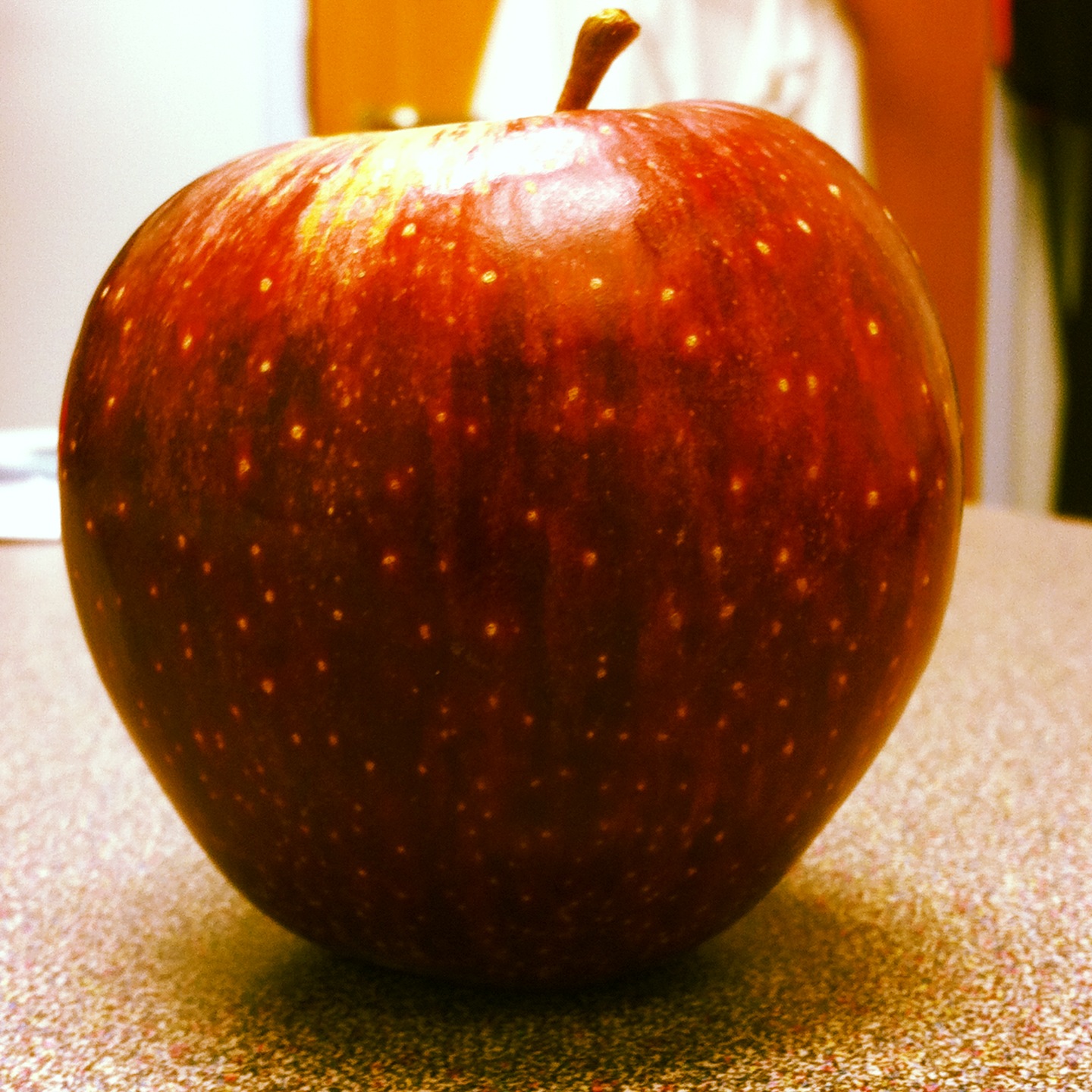
Specifically, this apple.

2013-10-24 15.59.46
This past weekend my family was visiting the upstate and we took the kids to pick apples at Bryson’s Apple Orchard. Not only did we get a bunch of delicious apples, but the kids got to learn a little about where apples come from. As kids tend to do, they ate as they picked, and noticed immediately that the fresh-picked apples were much tastier than the ones from the grocery store. They even got to meet “Farmer Bryson,” who appreciated our business and the kids’ enthusiasm.
And this is the point of Food Day: learning where food comes from, eating fresh foods, and supporting local farmers. I tried to explain this to my kids while we were driving home from the farm, but they were more interested in eating the apples they had just picked!