Tag Archives: exercise

Why BMI matters–Commentary from my soapbox.

My Health & Fitness column in the Aiken Standard this week is about body mass index (BMI), the most commonly used measure of body fatness and health. It was prompted by a recent article in the journal Science that raised familiar questions about whether or not BMI is a valid indicator of obesity and health.

This lead to reports in the popular media about BMI, like this one in Time magazine, the tone of which suggests that doctors and researchers who use BMI don’t know what they are doing. Since I use BMI in research and in practice, I  felt I should address both the article and share some other important points and additional thoughts about BMI.

1. BMI is so widely used because it is simple to measure – it only requires knowing height and weight – and because it is a good indicator of body weight and health risks. That said, it’s not perfect (see below). You can calculate your BMI here.

2. One of the biggest criticisms of BMI is that it can’t distinguish between fat and non-fat tissue, meaning that a person could have a high BMI but not be overly fat. The elevated BMI could be due to excess muscle, as is common in athletes. This is true: BMI doesn’t differentiate between muscle and fat. In fact, it isn’t even a measure of body fat. But in most cases, people who have a high BMI do have a high percent fat.

Don’t believe me? Then try what I call he Wal-Mart test. Go to Wal-Mart someday and measure the BMI and percent fat of everyone who comes through the door. What you will no doubt find is that the majority of the people who have a high BMI are overfat and relatively few have a high BMI due to excess muscle. This is why BMI works so well on a population level.

3. Even though BMI may misclassify some people as overfat when they aren’t, there is a simple way to avoid this: measure their waist circumference. People who have a high BMI due to excess muscle will have a narrow waist (think body builders) and those who are overfat will have a high waist circumference (think Homer Simpson). The point is that it is easy not to misclassify someone if they are in front of you.

4. Another criticism is that it is possible to have a normal BMI but have a high percent fat. This is something that we have seen in our lab and it almost always occurs in people who are thin but unfit–they don’t exercise.  The problem is that a normal BMI indicates good health, but if a person has a lot of fat they really aren’t very healthy.

This is also a valid criticism. And it is especially true if the excess fat is visceral fat, which is stored deep in the abdomen and is associated with higher risks of diabetes, hypertension, and heart disease. But there are other indicators of health risk beyond body fatness, including blood pressure, blood glucose, and blood cholesterol. BMI should be used in conjunction with these other factors to assess overall health.

5. Research also suggests that being overweight or obese according to BMI isn’t necessarily unhealthy and that having a normal BMI isn’t always better. But that is only part of the story. The part that gets left out is physical fitness. It’s true…research shows that the risk of death is lower among people who are overweight or obese but have a high level of physical fitness compared to normal weight individuals who are unfit.

This suggests that regular exercise (to become and stay fit) is at least as important as body weight in determining the risk of death. No question this is true!

However, this doesn’t mean that people who are “fit and fat” are necessarily healthier. The research shows a lower risk of death during a specific follow-up period, but doesn’t make claims about the health during that time. It is possible, even likely, that obesity is associated with some impairment of health—back pain, for example—that normal weight subjects might not experience. Exercise can reduce those problems, but there are likely still some reasons why losing some weight might benefit even those obese individuals who are fit.

Furthermore, I wonder how many obese people are fit enough to have a lower risk of death. I suspect that number is low. Maybe we should add a fitness test to the Wal-Mart test to find out.

6. These problems aren’t a failing of BMI itself, it is the fact that BMI isn’t meant to be used alone. BMI is just one measure of health. When used in combination with others, like waist circumference and physical fitness, BMI is a much better predictor of current and future health problems.

Using BMI alone and complaining that it doesn’t accurately assess health is inappropriate.  Your doctor wouldn’t measure just your blood pressure, find hat it is normal, and proclaim you healthy, right? The same is true for BMI.

With that said, I will step off my soapbox. At least for now.

Good advice for college students. And everyone else.

This came to my attention recently. It’s an infographic about how college students can stay active, get fit, and avoid the dreaded “Freshman 15.”

This is good advice for the rest of us, too. Replace dorm room with living room and cafeteria with kitchen and you have a simple and effective way to improve your health.

The Best Regimen for College Fitness

[The Best Regimen for College Fitness via The Best Colleges]

By the way, studies of weight gain during college show that it isn’t really the Freshman 15. Research shows it’s more like the Freshman 4.6. But that doesn’t have the same impact, does it?

Why your diet may not be working as well as you hoped (and how to fix it).

Many people follow a diet to lose weight, treat health conditions such as high blood pressure, high cholesterol, or diabetes, or to feel “healthier.” Some of these diets are based on research (the DASH diet, Mediterranean diet, etc.) and others are simply trendy at the moment (the Paleo diet).

There is great debate about which diet is the best. Unfortunately, there are no good answers to that question. The good news is that almost all diets are good,  meaning that they are at least partially effective for improving some health measure. People do lose weight following even the most ridiculous diets, right?

It turns out that the diet is only one part of an effective strategy for weight loss or lowering blood pressure, cholesterol, or glucose. The other essential factor is  physical activity!

Regular exercise, or pretty much any activity, is important for several reasons. For a person trying to lose weight, exercise adds to weight loss and helps keep the weight off later. Nutritional interventions for diabetes, osteoporosis, high blood pressure, and high cholesterol are all more effective with exercise.

The idea that a diet is more effective when combined with exercise is the topic of my Health & Fitness column in the Aiken Standard this week.

What kids will be missing when they go back to school.

My Health & Fitness column in the Aiken Standard this week is about the experience of heading back to school. But it’s really about what most kids won’t experience when they are in school—any meaningful education about nutrition, activity, and health.

To be sure, the time that students spend learning the math and science, reading and writing, and art and music is time well spent. Unfortunately, though, in most schools, this comes at the expense of health education. In fact, opportunities for children to be active in school, either through formal physical education or more informal play and recess, has declined over the years. Good nutrition isn’t likely to get much classroom time at any level and the food served in most school hardly sends a positive message about healthy eating. These are missed opportunities!

This isn’t new, of course. I have written about the both the importance of physical activity for growth and learning for children (and adults, too) and the impact of these missed opportunities before. And I’m certainly not the only one to take notice. Probably the most widely known advocate in this area is Jamie Oliver, and his efforts made nutrition and health in schools topics for discussion among parents, teachers, administrators, and politicians alike.

Exercise now can help you pass your vacation fitness test.

There are loads of good reasons to sit less, move more, and get regular exercise. But beyond the health and fitness benefits, regular physical activity can help you enjoy your next vacation even more. This is the topic of my Health & Fitness column in the Aiken Standard this week.

Since most vacations involve activity during sightseeing, visiting a theme park, or other pursuits, it can be a challenge to people who spend much of their time being sedentary. A long day (or two or three) at Disney World is actually a pretty good fitness test. And being active in your non-vacation life can help you fare better.

In the column I cited a study that shows that people feel better following an active vacation. You can read that study here.

Go for a swim!

It’s summer and it’s hot, so it seems like a good time to write about the health and fitness benefits of swimming. Which is exactly what I did in my Health & Fitness column in the Aiken Standard this week.

Swimming is a great way to get in shape, build muscle, and to help you lose (and maintain) weight. Lap swimming is is about as aerobically demanding and burns as many calories as land-based exercise such as walking or jogging. (Obviously, it depends on the stroke you use and how fast you swim).

Since water is more dense than air, aquatic exercise is lower impact that exercise on land. This means that water aerobics, aqua walking or jogging, and resistance training using foam “weights” or webbed gloves can be done by people with conditions such as arthritis or for injury rehabilitation.

Even swimming leisurely or playing in a pool or lake can burn a substantial number of calories, so it is a healthy way to beat the sumer heat.

If you are interested in using your pool for exercise, you can find information about aquatic exercise in general here and links to suggested exercises here. You can learn more about aquatic exercise specifically for arthritis and fibromyalgia, too.


My son, the Michigan State Police, and healthy choices at McDonald’s

Earlier this evening my family went for a bike ride. That’s when my son got pulled over by the Michigan State Police and was given a ticket!

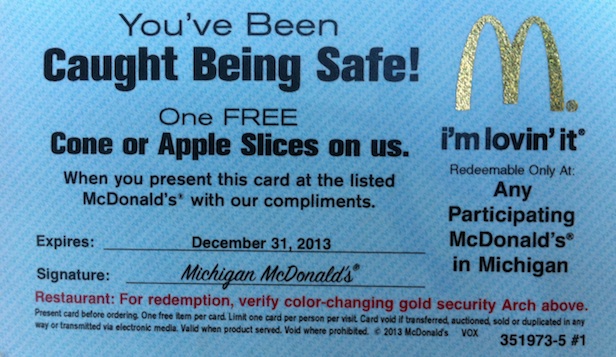
He was pulled over for being safe by wearing a helmet and the “ticket” was a card for a free ice cream cone at McDonald’s.

It is part of a program that rewards kids for being safe and wearing a helmet when they ride a bike. Since we were all wearing helmets, my oldest son (and his two younger brothers) got “tickets” from the police officer.

It was when we got home and I looked at the card more closely that I noticed something nice—the card is good for either a free ice cream cone OR apple slices.

icecream_or_apples Bike_helmet

I’m sure almost all kids will pick the cone (I know my kids will!), but it’s nice to have a healthy option.

Go for a walk when you fly. Ideas for staying active when you travel.

I typically don’t travel much, but I have been on several trips in the past month or so. Since I’m a bit of an activity geek, I have been noticing the opportunities for and barriers to activity that are present when traveling by air. For the most part, flying involves a lot of sitting—on the plane and in the airport waiting for flights. But it doesn’t need to be this way.

Staying active when you travel is the topic of my Health & Fitness column in the Aiken Standard this week. Of course, I’m not the only one who tries to move more when I fly, both on the plane and in the airport. For example, this guy takes being active between flights to a whole new level. (Yes, he is my hero.)

While it is possible to use your time in the airport to be active, it isn’t always the first thing you think of. Even though nearly everyone does some walking in the airport, moving walkways and trains are an easy alternative to walking the sometimes long distances between terminals. Some airports are better than others at encouraging active transportation in the airport.

For example, the Hartsfield-Jackson airport in Atlanta has a train that runs between the terminals. Right next to the train is a walkway that also connects the terminals. There are signs that tell you how far you have to go (it’s a little less than 1/4 mile between terminals) and art, history, and local information displays line the walkway. Other airports do this too, and some have elaborate light and music shows to keep you entertained. Others have dedicated spaces for exercise, like the yoga room in the San Francisco airport.

Not every airport has made this level of effort to help travelers be more active, but this should change in the future. The American College of Sports Medicine has a Healthy Air Travel task force that aims to develop more opportunities for activity in airports by providing information and other resources to airport management and travelers.

You should also try to be active during your flight, too. Getting up out of your seat (when allowed, of course) or doing simple foot and leg exercises is a good idea. This is recommended to reduce the risk of blood clots that could develop during prolonged sitting. Even though the risk of these blood clots, commonly called “economy class syndrome,” may be low, moving around during a flight is still a good idea.

Between limiting prolonged sitting during the flight and walking more in the airport, my guess is that some people probably get more activity on days when they fly!

Of course, there is another whole aspect of healthy travel that I haven’t addressed: making smart decisions about what to eat for meals and snacks. But that is a story for another time…

Keep your cool. How to exercise, work, and play safely in the heat.

My Health & Fitness column in the Aiken Standard this week is about exercising, working, and playing safely in the summer heat. By planning ahead and taking frequent breaks, you can help make your outdoor time safer and more fun for everyone.

You can learn more about exercise in the heat (both low-sci and high-sci information) from the American College of Sports Medicine:

Preparing for and Playing in the Heat (this is a low-sci article)

Exertional Heat Illness  During Training and Competition  (This is an ACSM position stand, so it is pretty high-sci)

You can hear from a true expert on exercise in a hot environment in this video. Dr. Brent Ruby is the director of the Center for Work Physiology and Environmental Metabolism at the University of Montana. The guy on the treadmill is Tim Hampton, one of my former students and now a graduate student in Dr. Ruby’s lab.

Marathon Minute: Overheating, not dehydration, is the danger [Via KECI]

Your schedule for staying active at work, from Lifehacker (and me).

The negative health effects of sitting all day at work are well established, and incorporating activity into your day isn’t as difficult as it might seem. But it is easy to get busy and forget to take even a few minutes to be active.

Problem solved! The good people at Lifehacker have come up with a schedule to help you remember to stretch and strengthen throughout the day at work. And I got to help!