Tag Archives: childhood obesity

What parents and schools can do to make sure kids are ready to learn

Physical activity and good nutrition have long been recognized as essential for promoting good health in adults and children. More and more research suggests that these health behaviors can have beneficial effects beyond health, including how we perform both physically and mentally. The emphasis here is on children in school, but it applies to adults, too.

Unfortunately, taking time for activity and good nutrition is seen as a luxury or a distraction to learning in most schools. Far from being a distraction, physical activity and healthy eating are prerequisites for learning and academic achievement. In short, these often ignored factors can help make sure children are ready to learn.

Regular physical activity is essential for good health, growth, and physical development, including maintaining a healthy body weight. This last point is important given the epidemic of childhood obesity and related health problems, including “adult” diseases like high blood pressure and type 2 diabetes.

Current recommendations call for all children to get at least 60 minutes of activity per day. This can include activity at school from physical education classes, recess, other classroom activities as well as games, sports, and unstructured play. Unfortunately, most kids don’t get nearly enough activity at school and many aren’t active at home.

Physical activity is also important for academic performance. Research shows that children who participated in an activity program had better executive control, which includes resisting distractions and maintaining focus, improved memory, and doing better switching between tasks. This is particularly relevant for children with ADHD, but the effects can be seen in all kids. These positive changes can maximize class time and lead to improvements in academic achievement, especially math and reading test scores.

Similarly, good nutrition is also essential for health, growth, development, and academic achievement. Eating a good breakfast improves cognitive function, alertness, and academic performance in students of all ages. It should be no surprise, then, that skipping breakfast impairs cognitive function and academic achievement. This is one reason that many schools offer breakfast to start the day or include a healthy mid-morning snack.

The same is true for lunch, too. A good lunch can support learning in the afternoon and gives a chance to teach kids about good nutrition by providing healthy food that, unfortunately, many children may not get at home.

Schools have a unique opportunity to use physical activity and nutrition to promote health, support academic achievement, and teach healthy habits. Since formal nutrition education is missing from most curriculums and PE programs are being reduced or cut completely, schools must be creative to incorporate these essential subjects.

A way around this problem is to make sure children get a chance to move and play, ideally multiple times during the day. This is what recess is for. Teachers can also incorporate activity and nutrition education in the classroom and get away from the idea that kids must be sitting still to learn. As research shows, quite the opposite is true!

Schools are often hesitant to teach about nutrition and activity because it is thought of as a responsibility of parents, not schools. But most parents don’t teach these good habits at home, which affects what happens at school. Despite the obvious benefits, it will probably take years of effort to change this view.

In the meantime, parents can encourage their kids to be active and make smarter food choices at home so they are ready to learn in school.
Fat still matters

Last week I wrote about some recent research suggesting that low-carbohydrate diets may be better for weight loss that low-fat diets. For many, this study reinforced the notion that traditional recommendations are wrong and that the key to good health is to eliminate carbohydrates from your diet. This couldn’t be further from the truth.

The recent study did show that people lost more weight and experienced beneficial changes in blood lipids when they followed a low-carbohydrate diet compared to those who ate a low-fat diet. However, this does not mean that low-fat diets aren’t effective for weight loss or that they are “unhealthy.”

In fact, low-fat diets have long been used effectively to promote weight loss, reduce heart disease risk, and lead to healthier eating in general. This is supported by the results of hundreds of research studies as well as the practical experience of health professionals and real people. Here are two reasons why fat still matters when it comes to health.

First, reduced-fat diets have been shown to improve blood cholesterol and lower the risk for heart disease. Eating a diet low in fat, especially saturated and trans fat, has been the foundation of nutrition recommendations for decades. The fact is that these diets are effective for weight loss, reducing cholesterol, and otherwise improving heart health.

One famous study demonstrated that following a low-fat diet contributed to a reduction in the severity of atherosclerosis, the narrowing of arteries that leads to many heart attacks. Literally hundreds of other studies have shown similar beneficial results.

This isn’t some magical effect of eating less fat, though. The health benefits are likely due to eating more vegetables, fruits, and whole grains as much as they are to reducing fat intake. The point is that adopting a low-fat diet can lead to better nutrition overall.

Second, reducing fat intake is a good way to reduce calories. This is true because fat contains nine calories per gram, more than twice that of carbohydrates and protein, so cutting fat is an effective way to cut calories. Limiting fat intake also reduces calories indirectly because many high fat foods are also high in sugar and calories (think of most desserts).

It is important to mention that simply reducing fat intake won’t always lead to weight loss; total calories must be lower, too. This is a mistake many make when they reduce fat intake, but increase the amount of calories from other sources, typically carbohydrates. Many low-fat foods are actually relatively high in calories due to added sugar or people tend to eat more of them (the SnackWell Effect).

The effectiveness of low-fat diets for weight loss has been demonstrated in research studies (like this one) and countless weight loss programs. In one notable study, a diet low in fat even led to weight loss in people who weren’t trying to lose weight. And don’t forget that in the recent study about low-carbohydrate diets, the subjects that followed the low-fat diet also lost weight.

For some people, cutting carbohydrates as a way to lose weight is reasonable; for others, reducing fat intake makes sense. For most people, though, doing both to some extent is the best option, but going to extremes is unnecessary.

Eating less added sugar and avoiding foods with added fats (such as French fries) are good recommendations for almost everyone. That said, there is little evidence for the benefit of limiting carbohydrates in the form of whole grains, legumes, vegetables, and fruits or the fat in meat and dairy.

The bottom line is that the quality of food we eat is more important than the specific amounts of the nutrients it contains. Eating low-carbohydrate or low-fat diets can help steer you toward making healthier choices, but so can avoiding processed foods in favor of wholesome, nutrient-dense “real” food.

Good sources of protein for your low-carb diet

Thanks to a recent study and media coverage (including me), low-carbohydrate diets are a popular topic of discussion. For many people, cutting back on carbohydrates is a good way to reduce calories to promote weight loss.

Most low-carbohydrate diets also emphasize protein intake. But finding healthy protein sources is important for promoting weight loss and good health.

This recent discussion about the best protein for optimal weight loss  on the Train Your Body show on RadioMD should help.

The physical activity report card is in. We pretty much failed.

The spring semester just ended at the university where I teach. Which means my colleagues and I have been busy evaluating our student’s progress and submitting grades.

About this time, another report card came in from the National Physical Activity Plan evaluating physical activity in U.S. children. The results aren’t good. In fact, we pretty much failed! This is the topic of my Health & Fitness column in the Aiken Standard this week.


It’s probably no surprise that the majority of Americans are not active enough. Only about half of adults meet even the minimum recommendation for physical activity of 30 minutes per day, five days per week. Compounding this problem is the fact that many people spend much of their time at work and home being sedentary—some spend over 12 hours per day sitting!

Low levels of physical activity is associated with an increased risk of heart disease, stroke, some cancers, and, of course, obesity in adults. Becoming more active is probably the most important change a sedentary person can make to improve their health. The impact is similar to a smoker who quits.

What may be surprising is that this is a problem for children, too. Less than half of children ages 6–11 are active for 60 minutes per day. Among teenagers, it is less than 10%! The health effects of too little activity in kids is similar to that of adults.

The combination of inactivity and obesity can lead to “adult” diseases such as type 2 diabetes in young people. For this reason, some experts predict that this generation of children may be the first ever to die at a younger age than their parents.

Current recommendations call for children under the age of 18 to attain at least 60 minutes of moderate-to-vigorous activity at least five days per week. In younger kids this can be achieved through active play. In teens it is more likely to include organized sports and games.

The National Physical Activity Plan is a set of recommendations, programs, and initiatives designed to promote an active lifestyle at work, school, and home for all Americans. It was established by an alliance of health professionals and researchers.

This group recently released a report card on physical activity for children and youth that graded the success of efforts to promote activity in several areas. The results show that we are failing to meet even minimum goals and recommendations. Here is a summary of that report card:

Overall physical activity: D-Only 42% of 6–11 year old children and just 8% of kids ages 12–15 meet the 60 minutes per day activity goal.

Sedentary behaviors: D. About half of all children spend more than the recommended upper limit of two hours of screen time, which includes TV, computer, and video games, per day.

Active transportation: F. Just over 10% of children walk or bike to school regularly.

Physical education in school: C-Only about half of children attend at least one PE class per week.

Based on these grades, American children are not getting enough physical activity. But it isn’t fair to say that our children are earning these grades—it’s the adults who are failing! Most children are at the mercy of parents, teachers, and other adults who decide how they will spend their time at school and at home.

The report card shows that we are either not allowing our kids to be active enough or limiting opportunities for them to move and play. This isn’t necessarily a conscious effort, but is likely a consequence of the physical activity habits of adults that our children adopt.

Given the importance of regular activity for growth, development, health, and even academic success, getting our kids to be more active should be among our highest priorities. This requires both individual action and organized community efforts to make physical activity and exercise a part of every child’s day.

And while we are at it, we (the adults) should make this same effort. Perhaps the failing grades on the recent report card will motivate us.

Stealthy Healthy Eating

My Health & Fitness column in the Aiken Standard this week is about the many processed foods that include added nutrients, primarily vitamins, minerals, and fiber, to make them healthier. While this seems like a good thing—helping people get enough essential nutrients, even if they eat a poor diet—there are drawbacks to using these foods instead of eating actual food that contains these nutrients.


What if there was a way to get the benefits of eating vegetables without having to eat any vegetables? This may be a dream for millions of American children and adults who don’t eat enough vegetables.

Thanks to creative food processing, the healthy components of vegetables can be added to many foods, including soda, candy bars, and other sweets. Books and websites contain recipes for adding pureed vegetables to brownies and other baked goods. There is even a new line of prepackaged pureed vegetables to use!

The recommended intake of vegetables ranges from one cup per day for young children to 3 cups for adults. A simpler guideline is to fill half of your plate with fruits and vegetables at each meal. The goal should be to eat a variety of vegetables throughout the week.

There are plenty of good reasons for people to eat vegetables. Most vegetables are a low-calorie source of essential vitamins and minerals. The dietary fiber found in vegetables (and fruits and whole grains) plays a role in maintaining a healthy body weight, lowering cholesterol, and reducing the risk of some cancers.

Fiber is increasingly added to processed foods including granola bars and energy bars. It is possible to get up to half of your daily recommended intake of fiber by eating a single Fiber One bar. That is the equivalent of a cup or more of most vegetables! Considering that many of these snacks are essentially candy bars, they are a tasty way to get fiber.

Vitamins and minerals have long been available as supplements and added to certain foods, including products made from grains like pasta and bread. But now you can get vitamins in many soft drinks, many of which have as much sugar as soda. And calcium is added to a variety of foods from breakfast cereals to snacks.

There are, of course, some benefits of doing this. People who don’t eat a healthy diet can get enough essential nutrients through these products. Some of these foods are low in calories so they can help people who are trying to lose weight.

While these “hidden” nutrients may seem like a good solution for people who don’t eat enough vegetables, this form of stealthy healthy eating may have some negative consequences.

These processed foods may be high in sugar, fat, and calories which could contribute to weight gain. The fact that these foods are designed to taste good—many include chocolate—may lead people to overeat. Aside from excess calories, eating far too much fiber could cause GI discomfort or other health problems.

More concerning, though, is the fact that these foods set an expectation that healthy foods should be sweet. This is particularly problematic in children, who may avoid eating vegetables (and other healthy foods) in favor of sweet drinks and snacks that contain the same nutrients.

Additionally, getting vitamins, minerals, and fiber through processed foods keeps people from learning how to make healthy choices and prepare real food. This has consequences for developing healthy eating habits in both children and adults.

Focusing on getting individual nutrients over eating a variety of healthy foods is thought to be an important cause of the current obesity epidemic. Relying on processed foods with added vitamins, minerals, and fiber may be doing more harm than good to your health.

The bottom line is that you should get your nutrients from real food and balance what you eat with daily physical activity. Remember, good health comes from making smart choices, not from a bottle or a box!

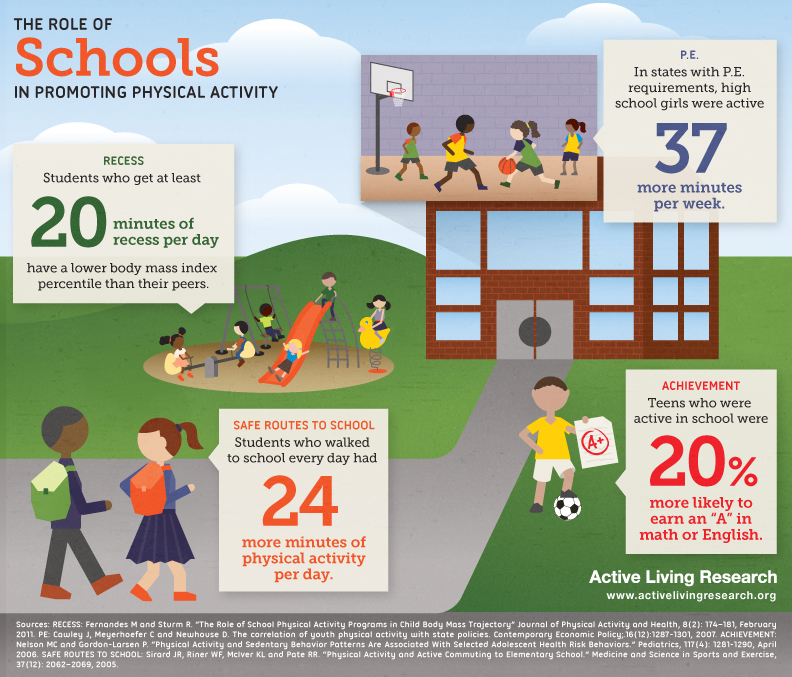
Physical activity at school in two infographics

This week I came across two infographics explaining the benefits of including physical activity in the school day and ways kids can be active at school.

Having opportunities to be active throughout the day benefits children in many ways, from improving their health, helping them maintain a healthy weight, and promoting learning. In fact, physical activity through recess, structured PE class, and other unstructured activities is absent at many schools. This represents a missed opportunity to teach children about the importance of being active.

According to these infographics, though, engineering activity into the school doesn’t have to be difficult. And including physical activity in the school day makes children believe it is important (which it is) and helps develop habits that will last into adulthood.

alr_schools

The Role of Schools in Promoting Physical Activity | via Active Living Research


Screen Shot 2014-03-06 at 8.14.35 PM

Get 60 Minutes | via Institute of Medicine


Now if we could just do something about the quality of school lunches!

Just in time for Childhood Obesity Awareness Month: The completely unauthorized and ill-advised childhood obesity experiment

September is Childhood Obesity Awareness Month, which is the topic of my Health & Fitness column in the Aiken Standard today.

Although the causes involve a complex interaction of genetic, biological, behavioral, and environmental factors (as this article explains), most cases likely involve too little activity and too much energy intake, particularly added sugars. It is important to note that both diet and activity play a role, and both a targets for prevention and treatment. The same is true for adults, too.

Obesity among children, both young kids and teenagers, is associated with serious health, social, and psychological problems. In fact, obese children, especially those who are inactive, tend to develop “adult” diseases including high blood pressure and diabetes.

And while we know that obesity and inactivity in kids is a problem, I don’t think we realize how bad it is now or will be in the future. That’s because no one has any idea what will happen to an obese 12-year old who develops type 2 diabetes. Adults who become diabetic are at higher risk for an early heart attack; does this mean that a 12-year old will be on the fast track  toward a heart attack at age 30?

We don’t know. But I think we are going to find out. Unfortunately, it’s as though we are experimenting with a generation of children to find out.


News from CSPI: 97% of Kids’ Meals Flunk Nutrition at Chain Restaurants

I just read this today but it is from about a month ago, so you may have seen it already.

97% of Kids’ Meals Flunk Nutrition, as Fried Chicken Fingers, Burgers, Fries, Soda Dominate at Chain Restaurants ~ Newsroom ~ News from CSPI ~ Center for Science in the Public Interest.

Recently I  wrote about how popular children’s breakfast foods—cereal, Pop-Tarts, and “juice” drinks—more closely resemble candy and soda than a healthy meal to start the day.

When it comes to eating at many restaurants it appears that most kid’s meals more closely resemble an unhealthy adult meal than a healthy lunch or dinner appropriate for a child.

While we (parents) are responsible for making healthy choices for our kids, it is challenging given the general lack of good options. There are exceptions, of course, including the Fresh Fit for Kid’s meals at Subway that were mentioned in the CSPI article and healthy kid’s meals at EarthFare.