Tag Archives: nutrition

In vitro beef and other fake food.

My Health & Fitness column in the Aiken Standard this week is about the in vitro burger you no doubt heard about in the news. Would you eat meat that was created in a laboratory? Many people would say no, mostly because it seems “unnatural.”

But most of us eat plenty of processed and modified foods every day. Aren’t these foods also unnatural?

You can learn more about the story behind the creation as well as results of the first taste test of the “test tube” burger at the following links:

A good New York Times story about the taste test here.

An article in Scientific American here:

If you are looking for something to listen to while you exercise, try this radio story on Science Friday on NPR.

Another New York Times story about the creation of the burger is here.

What kids will be missing when they go back to school.

My Health & Fitness column in the Aiken Standard this week is about the experience of heading back to school. But it’s really about what most kids won’t experience when they are in school—any meaningful education about nutrition, activity, and health.

To be sure, the time that students spend learning the math and science, reading and writing, and art and music is time well spent. Unfortunately, though, in most schools, this comes at the expense of health education. In fact, opportunities for children to be active in school, either through formal physical education or more informal play and recess, has declined over the years. Good nutrition isn’t likely to get much classroom time at any level and the food served in most school hardly sends a positive message about healthy eating. These are missed opportunities!

This isn’t new, of course. I have written about the both the importance of physical activity for growth and learning for children (and adults, too) and the impact of these missed opportunities before. And I’m certainly not the only one to take notice. Probably the most widely known advocate in this area is Jamie Oliver, and his efforts made nutrition and health in schools topics for discussion among parents, teachers, administrators, and politicians alike.

The best answer I have seen to questions about dietary supplements

I get a lot of questions about nutritional supplements. Should I take (fill in the blank)? Will it help me lose weight? What would I recommend? Most of the time, my answers are disappointing.

Since there is very little research to support big benefits of taking supplements, I tend to respond with something like this: “There is no good reason* why you should take supplements so it probably won’t help much. I  probably won’t hurt you either, so if you have the extra money, go ahead.”

*Unless your physician tells you to. And tell your physician about supplements you do take.

I recently read a much better response. It’s from Marion Nestle, a professor, writer, and all-around expert about all things nutrition. It’s from a Q&A on her blog, Food Politics. You should make it part of your regular reading.

Q: Why are you so hard on nutritional supplements? You must be one of those people who thinks they kill people.

A: Don’t get me wrong. Nutrient supplements are great for people who have nutrient deficiencies. Whether they make people worse is arguable, but study after study shows that nutrient supplements do not make healthy people healthier. If you like to take supplements, I’m guessing you don’t care much about what the science says. Supplements aren’t about evidence-based medicine. They are about deep distrust of modern diets, science and the health care system. If nothing else, supplements are powerful placebos, and I’m not at all convinced they are seriously harmful. My advice: Supplements, like everything else about nutrition, should be taken in moderation.

Good, right? Why didn’t I think of that?

Food science beach reads: learn about food and cooking while you work on your tan

My Health & Fitness column in the Aiken Standard this week is a summer reading list of books about food  and cooking. It turns out that most people really don’t understand what they are eating or the processes that went into cooking their food. Knowing how food is prepared can help you make healthier eating choices, whether you are doing the cooking yourself or if you are eating prepared meals.

Here are three books about food science you can take to the beach (and one you can’t):

Cooked: A Natural History of Transformation by Michael Pollan

This is the most recent of Pollan’s excellent books, all of which should be required reading for anyone who eats. You can hear a nice interview with him about Cooked here and one about a previous book here (both are from Science Friday on NPR).

On Food and Cooking: The Science and Lore of the Kitchen by Harold McGee

Harold McGee also contributed to an excellent series about coffee on Science Friday on NPR. It turns out we can learn a few things about the first thing many of us consume each day.

McGee also has/had a column in the New York Times called the Curious Cook. It doesn’t appear to have been updated recently, but the older posts are still worth a read.

What Einstein Told His Cook: Kitchen Science Explained and What Einstein Told His Cook 2, The Sequel: Further Adventures in Kitchen Science by Robert Wolke

Robert Wolke also used to write a column called Food 101 in the Washington Post. The old articles are still available and worth checking out.

Modernist Cuisine: The Art and Science of Cooking by Nathan Myhrvold

This one is a workout both to read (it is a collection of six books) and to carry to the beach (it weighs over 50 lbs)! Even if you don’t buy it (it costs over $500) it is worth a look—the pictures of the cooking processes are amazing. In fact, a book of photos called The Photography of Modernist Cuisine is available for pre-order now.

My son, the Michigan State Police, and healthy choices at McDonald’s

Earlier this evening my family went for a bike ride. That’s when my son got pulled over by the Michigan State Police and was given a ticket!

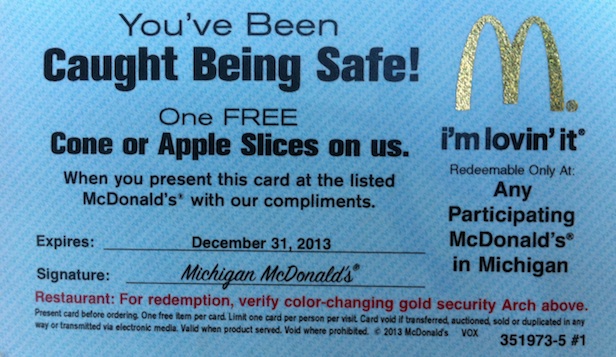
He was pulled over for being safe by wearing a helmet and the “ticket” was a card for a free ice cream cone at McDonald’s.

It is part of a program that rewards kids for being safe and wearing a helmet when they ride a bike. Since we were all wearing helmets, my oldest son (and his two younger brothers) got “tickets” from the police officer.

It was when we got home and I looked at the card more closely that I noticed something nice—the card is good for either a free ice cream cone OR apple slices.

icecream_or_apples Bike_helmet

I’m sure almost all kids will pick the cone (I know my kids will!), but it’s nice to have a healthy option.

Deceptive food labeling, old school style.

This isn’t a deceptive label on a food package, but it is an example of misleading nutrition information. It is a recipe from a cookbook called Charleston Receipts, which includes recipes that represent hundreds of years of low country cooking. I don’t know the history of this particular recipe, but I do know that it makes a  claim that, upon closer examination,  isn’t exactly true.

The recipe is for Sugarless Yellow Cake, which sounds healthy, especially for people who are trying to lose weight or control their blood glucose. But reading the ingredients reveals that this cake is definitely NOT sugarless.

Sugarless yellow cake

Okay, technically, it doesn’t contain sugar as an ingredient. But it does contain corn syrup, which really is sugar (as so clearly explained here).

Like many foods, especially packaged foods, the name tells one story while the ingredients tell another. Since this recipe comes from a book that was originally published in 1950, this form of misleading labeling isn’t anything new.

The Health and Fitness guide to surviving a zombie apocalypse.

So, my Health & Fitness column in the Aiken Standard this week is about zombies. More specifically, how a healthy diet and regular exercise can improve your chances of escaping a zombie invasion. Which is something that some people worry about.

If you aren’t worried about a zombie apocalypse you might be after seeing the movie World War Z, which opens this week.

Oddly, this isn’t the first time that I have managed to link nutrition and fitness with zombies.

My Friend Shannon is in the newspaper!

My Health & Fitness column in the Aiken Standard this week is about my friend Shannon and her remodeling project. I have been writing about Shannon on this blog for some time, but I thought her story was worth sharing elsewhere.

Shannon has been trying to do what I call remodeling–losing a little weight and adding some muscle. To do this she started an exercise program and is now exercising nearly every day. She has also changed her diet, focusing mostly on eating out less, reducing portion sizes, and eating more fruits and vegetables.

It has been working!

What is interesting about Shannon is that the specifics of her diet and exercise program aren’t the reason for her success. Yes, that is how she lost fat and added muscle, but she could have done that following almost any diet and exercise program.

What helped Shannon the most is that she changed her habits. For years she didn’t exercise much and ate a diet that consisted largely of unhealthy foods. This was mostly due to convenience–it was easier to eat out and not exercise.

Changing these behaviors was the real challenge. Shannon’s lifestyle and interactions with others supported her former habits. And changing these habits isn’t easy. It means saying “no, thank you” a lot and making difficult choices about what to eat and when to exercise.

But she has done it and learned along the way that she really can make those tough decisions. And so can everyone else. The key is to focus on WHY we eat what we eat and WHY we don’t exercise rather than obsess about exactly WHAT to eat and WHAT to do for exercise.

What is one portion?

I think everyone knows that we have become accustomed to large portion sizes. And large portion sizes can add up to too many calories which can add up to weight gain.

Unless you have read a food label and carefully measured out one serving you may not realize how big your “normal” portions really are. This video will show you:

When you are done with that one, check out this video that shows what 2000 calories, the “typical” recommended daily intake, looks like coming from some of your favorite foods:


Using a physical activity time machine to explain the obesity epidemic.

What caused the current obesity epidemic? Is it that we are eating more now? Or are we less active than we were? Most likely, it is a combination of both. And although the typical American diet is given plenty of blame for causing people to gain weight, a low level of physical activity deserves attention, too.

One way to answer this question is to look back at what life was like about 100 years ago, when obesity was uncommon. Unfortunately, no one thought to make accurate measures of daily activity back then. But there is a way to go back in time and assess the diet and physical activity that was common 100 years ago.

In my Health & Fitness column in the Aiken Standard this week I wrote about an interesting study that essentially took researchers back in time to measure physical activity. The results show that we are much less active today, which certainly plays a big role in the obesity epidemic.

You can learn more about the study I mentioned here.