Tag Archives: nutrition

Food science beach reads: learn about food and cooking while you work on your tan

My Health & Fitness column in the Aiken Standard this week is a summer reading list of books about food  and cooking. It turns out that most people really don’t understand what they are eating or the processes that went into cooking their food. Knowing how food is prepared can help you make healthier eating choices, whether you are doing the cooking yourself or if you are eating prepared meals.

Here are three books about food science you can take to the beach (and one you can’t):

Cooked: A Natural History of Transformation by Michael Pollan

This is the most recent of Pollan’s excellent books, all of which should be required reading for anyone who eats. You can hear a nice interview with him about Cooked here and one about a previous book here (both are from Science Friday on NPR).

On Food and Cooking: The Science and Lore of the Kitchen by Harold McGee

Harold McGee also contributed to an excellent series about coffee on Science Friday on NPR. It turns out we can learn a few things about the first thing many of us consume each day.

McGee also has/had a column in the New York Times called the Curious Cook. It doesn’t appear to have been updated recently, but the older posts are still worth a read.

What Einstein Told His Cook: Kitchen Science Explained and What Einstein Told His Cook 2, The Sequel: Further Adventures in Kitchen Science by Robert Wolke

Robert Wolke also used to write a column called Food 101 in the Washington Post. The old articles are still available and worth checking out.

Modernist Cuisine: The Art and Science of Cooking by Nathan Myhrvold

This one is a workout both to read (it is a collection of six books) and to carry to the beach (it weighs over 50 lbs)! Even if you don’t buy it (it costs over $500) it is worth a look—the pictures of the cooking processes are amazing. In fact, a book of photos called The Photography of Modernist Cuisine is available for pre-order now.
My son, the Michigan State Police, and healthy choices at McDonald’s

Earlier this evening my family went for a bike ride. That’s when my son got pulled over by the Michigan State Police and was given a ticket!

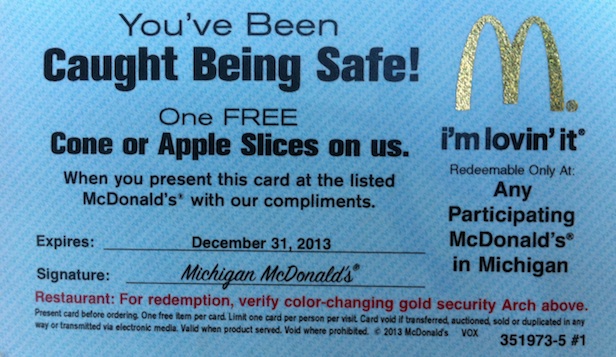
He was pulled over for being safe by wearing a helmet and the “ticket” was a card for a free ice cream cone at McDonald’s.

It is part of a program that rewards kids for being safe and wearing a helmet when they ride a bike. Since we were all wearing helmets, my oldest son (and his two younger brothers) got “tickets” from the police officer.

It was when we got home and I looked at the card more closely that I noticed something nice—the card is good for either a free ice cream cone OR apple slices.

icecream_or_apples Bike_helmet

I’m sure almost all kids will pick the cone (I know my kids will!), but it’s nice to have a healthy option.

Deceptive food labeling, old school style.

This isn’t a deceptive label on a food package, but it is an example of misleading nutrition information. It is a recipe from a cookbook called Charleston Receipts, which includes recipes that represent hundreds of years of low country cooking. I don’t know the history of this particular recipe, but I do know that it makes a  claim that, upon closer examination,  isn’t exactly true.

The recipe is for Sugarless Yellow Cake, which sounds healthy, especially for people who are trying to lose weight or control their blood glucose. But reading the ingredients reveals that this cake is definitely NOT sugarless.

Sugarless yellow cake

Okay, technically, it doesn’t contain sugar as an ingredient. But it does contain corn syrup, which really is sugar (as so clearly explained here).

Like many foods, especially packaged foods, the name tells one story while the ingredients tell another. Since this recipe comes from a book that was originally published in 1950, this form of misleading labeling isn’t anything new.

The Health and Fitness guide to surviving a zombie apocalypse.

So, my Health & Fitness column in the Aiken Standard this week is about zombies. More specifically, how a healthy diet and regular exercise can improve your chances of escaping a zombie invasion. Which is something that some people worry about.

If you aren’t worried about a zombie apocalypse you might be after seeing the movie World War Z, which opens this week.

Oddly, this isn’t the first time that I have managed to link nutrition and fitness with zombies.

My Friend Shannon is in the newspaper!

My Health & Fitness column in the Aiken Standard this week is about my friend Shannon and her remodeling project. I have been writing about Shannon on this blog for some time, but I thought her story was worth sharing elsewhere.

Shannon has been trying to do what I call remodeling–losing a little weight and adding some muscle. To do this she started an exercise program and is now exercising nearly every day. She has also changed her diet, focusing mostly on eating out less, reducing portion sizes, and eating more fruits and vegetables.

It has been working!

What is interesting about Shannon is that the specifics of her diet and exercise program aren’t the reason for her success. Yes, that is how she lost fat and added muscle, but she could have done that following almost any diet and exercise program.

What helped Shannon the most is that she changed her habits. For years she didn’t exercise much and ate a diet that consisted largely of unhealthy foods. This was mostly due to convenience–it was easier to eat out and not exercise.

Changing these behaviors was the real challenge. Shannon’s lifestyle and interactions with others supported her former habits. And changing these habits isn’t easy. It means saying “no, thank you” a lot and making difficult choices about what to eat and when to exercise.

But she has done it and learned along the way that she really can make those tough decisions. And so can everyone else. The key is to focus on WHY we eat what we eat and WHY we don’t exercise rather than obsess about exactly WHAT to eat and WHAT to do for exercise.

What is one portion?

I think everyone knows that we have become accustomed to large portion sizes. And large portion sizes can add up to too many calories which can add up to weight gain.

Unless you have read a food label and carefully measured out one serving you may not realize how big your “normal” portions really are. This video will show you:

When you are done with that one, check out this video that shows what 2000 calories, the “typical” recommended daily intake, looks like coming from some of your favorite foods:


Using a physical activity time machine to explain the obesity epidemic.

What caused the current obesity epidemic? Is it that we are eating more now? Or are we less active than we were? Most likely, it is a combination of both. And although the typical American diet is given plenty of blame for causing people to gain weight, a low level of physical activity deserves attention, too.

One way to answer this question is to look back at what life was like about 100 years ago, when obesity was uncommon. Unfortunately, no one thought to make accurate measures of daily activity back then. But there is a way to go back in time and assess the diet and physical activity that was common 100 years ago.

In my Health & Fitness column in the Aiken Standard this week I wrote about an interesting study that essentially took researchers back in time to measure physical activity. The results show that we are much less active today, which certainly plays a big role in the obesity epidemic.

You can learn more about the study I mentioned here.

Eating healthy and saving money–it can be done! And your family should try it.

I read this interesting article in USA Today about a family who is working together to lose weight by eating healthy and exercising more. The family is participating the USA Today’s Family Fitness Challenge, which provides them with expert advice.

Predictably, their fitness is improving and they are losing weight (over 100 pounds total so far). One family member even quit smoking!

What may be surprising is that they are saving money following their new healthier diet. By preparing most meals at home they are saving about $300 per week on food!

Another happy consequence is that they are spending more time together as a family by eating meals  and exercising together. No doubt this is good support for them as they try to improve their health.

They are doing this as part of  a TV show (The Doctors) and they have an exercise physiologist and a nutritionist working with them, so it would be easy to think that a typical family without this support wouldn’t be successful. I disagree.

I think that if most families started preparing dinners at home, eating as a family, and going for a walk (or doing some other activity) together after dinner they would get in better shape, lose weight, and benefit from more time together.

Read this before you go out for lunch today: Comparing fast food and casual dining restaurant meals.

Everyone know that fast food is unhealthy. Of course, some fast food is better than others and it is possible to get a reasonably healthy meal at a fast food restaurant. But if you are concerned about calories, fat, added sugar, and sodium in your diet, fast food probably isn’t the best choice.

Eating at a casual dining restaurant such as Applebee’s, Ruby Tuesday, and T.G.I. Friday’s must be healthier, right? Think again! My Health & Fitness column in the Aiken Standard this week addresses this issue.

According to data collected by one of my students, Kyle Sprow, this is not always the case.

He compared a typical meal from McDonald’s, Subway, and  Applebee’s. The Applebee’s menu includes Weight Watchers low-calorie options  in addition to the regular menu items, so he looked at both. We chose these restaurants because of their popularity and because their menus are consistent with other similar restaurants.

He was able to compare typical fast food (McDonald’s), “healthy” fast food (Subway), a typical meal at a casual dining restaurant (Applebee’s regular menu), and healthy options at the same restaurant (Weight Watchers menu). Here is what he found:

  • The sit-down restaurant meal is likely to be higher in calories and fat than fast food. This is due in part to large portion sizes.
  • A meal at Subway may be lower in calories and fat than a meal at McDonald’s, but depends on what type and size of sandwich (and condiments) you choose.
  • The Weight Watchers menu at Applebee’s really is much lower in fat and calories than the regular menu, even better than Subway.
  • No matter where you eat, you are likely to get a lot of sodium in your meal, at least 50% of your daily recommended intake even if you chose the “healthy” options.

So, what will you have for lunch today?


News from CSPI: 97% of Kids’ Meals Flunk Nutrition at Chain Restaurants

I just read this today but it is from about a month ago, so you may have seen it already.

97% of Kids’ Meals Flunk Nutrition, as Fried Chicken Fingers, Burgers, Fries, Soda Dominate at Chain Restaurants ~ Newsroom ~ News from CSPI ~ Center for Science in the Public Interest.

Recently I  wrote about how popular children’s breakfast foods—cereal, Pop-Tarts, and “juice” drinks—more closely resemble candy and soda than a healthy meal to start the day.

When it comes to eating at many restaurants it appears that most kid’s meals more closely resemble an unhealthy adult meal than a healthy lunch or dinner appropriate for a child.

While we (parents) are responsible for making healthy choices for our kids, it is challenging given the general lack of good options. There are exceptions, of course, including the Fresh Fit for Kid’s meals at Subway that were mentioned in the CSPI article and healthy kid’s meals at EarthFare.