How will you celebrate heart month? Here are some suggestions.

February is American Heart Month, a time to raise awareness about heart disease, the leading cause of death in the United States. My Health & Fitness column in the Aiken Standard this week includes four simple steps you can take to assess and lower your risk for heart disease. If you aren’t sure where to begin, these four steps should be a good start to prevent and treat heart disease.

You can learn more about heart disease and what you can do to prevent heart attack and stroke from the American Heart Association.


Expert weight loss advice (but not from me)

I was invited to speak to the Augusta Family Y Team Lean weight loss challenge participants last evening. The topic was exercise for weight loss. I put together a nice presentation that included important facts, practical advice, and a few funny (to me, at least) jokes. Since this is something I talk and write about a lot, I imagined that I would come off as a real expert.

Before I began, a couple who won the Team Lean competition last year shared their story and their secrets for success. Together they have lost 220 pounds in the past year (100 lbs. for her, 120 lbs. for him). They explained how they changed their diet and started exercising. Their emphasis was on how beneficial exercise was to their weight loss and their overall health. Their journey from dedicated non-exercisers to a couple who runs half marathons (her) and completes triathlons (him) was inspiring and taught a valuable lesson about the importance of exercise in losing weight and keeping it off. The true experts had spoken!

And then I took the stage and shared important facts, practical advice, and a few funny (to me, at least) jokes about exercise and weight loss.

Lance Armstrong and doping: What, how, and why

I wrote about Lance Armstrong, the doping allegations against him, and his admission that he used performance-enhancing substances during his professional cycling career in my Health & Fitness column in the Aiken Standard this week.

While he and his teammates used a variety of banned substances, the one that gets the most attention is blood doping through transfusions and EPO. You can learn more about this process and how it improves performance in cycling and other endurance events from Wikipedia and, if you are motivated,  a 2011 article in the journal Blood.

The evidence that Armstrong and his teammates engaged in an elaborate doping conspiracy is outlined in detail in the U.S. Anti-Doping Agency “Reasoned Decision” report.

What’s in your cart?

Eating out less frequently and having more meals at home is a good way to make your diet more healthy. Restaurant and take-out meals tend to be high in calories due to large portion sizes and high fat and sugar content. With a little effort, preparing meals at home allows you to include healthier foods like whole grains, fruits, vegetables, and lean meats and limit processed foods with added fats and sugars.

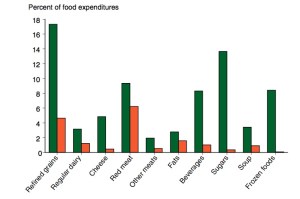
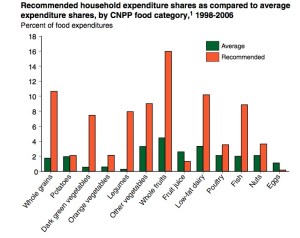
Of course, this assumes that you are purchasing healthy foods when you shop. But are you? This is the topic of my Health & Fitness column in the Aiken Standard this week. In it, I cite a report from the USDA’s Economic Research Service which offers some insight into what the average American buys at the market.  The following figures tell pretty much the whole story:

What we should be buying (but aren’t):

What we should eat

What we are buying (but shouldn’t):

What we do eat

You can access the full USDA report here: Assessing the Healthfulness of Consumers’ Grocery Purchases

You can learn more about what we should be eating and tips for making healthy choices in the Dietary Guidelines for Americans

It’s not about the diet

Last week I wrote about some characteristics of a good weight loss diet and what to avoid if your goal is to lose weight and keep it off. At about that time, the Best Diets rankings were published in U.S. News and World Report.

Despite this focus on diets and what to eat to lose weight, the key to long-term weight management isn’t food—it’s your ability to make good decisions and change your behaviors to support your weight loss goal. Sure, what you eat is important, and you should find a diet that is low in calories and teach you how to eat a healthy diet in the long run. But to make that diet work you need to alter your eating and activity habits. This is the difficult part, especially after the diet or weight loss program “ends”. (As people who have lost weight and kept it off will tell you, the effort never really ends)

To illustrate the importance of behavior change in achieving lasting weight loss, here are two examples of real people (with fake names) and how they overcame a major obstacle by changing their habits:

Andrea was a single mom who worked full-time and took classes toward her college degree. As you can imagine, her days were full and, even though she knew exactly what she should eat, she ate most of her meals on the go, often when driving. This meant that she ate a lot of take-out and fast food, typically as several snacks throughout the day as opposed to normal meals. Andrea struggled to lose weight and was getting frustrated that even though she knew what she should be eating, her lifestyle made this all but impossible. Then she decided to start packing food for herself. She actually carried two bags—one with her books and the other neatly packed with healthy snacks. This way she could have appropriate food with her everywhere she went. A yogurt in the morning at work rather than donuts from the kitchen or fruit and cheese instead of fast food while driving to pick up her kids at school. Preparing a day’s worth of food took time, but making this change made all the difference for Andrea.

Ed travelled a lot for work, which meant he spent long days on the road and ate out for most meals. Sitting all day in meetings and eating at restaurants with business associates made it almost impossible for him to stick with his diet or exercise program. He did his best to order salads, skip desert, and look for the healthiest options on the menu. No surprise, he ended up eating far more calories than he should and didn’t lose much weight. But skipping these meals wasn’t an option. Ed decided that since he couldn’t control his diet as much as he would like, he would focus his efforts on exercise. He started staying at hotels with fitness centers and woke up early to exercise before work. If he finished early in the afternoon he would use that time to go for a walk or go to the gym again before dinner. This wasn’t easy, but it was worth it. The exercise helped with weight loss directly by burning calories and indirectly by giving Ed a sense of control over his weight loss which motivated him to be even more careful ordering meals.

What Andrea and  Ed have in common is that, even though they were following the same diet (a low-calorie diet with daily exercise), their success came more from how they changed their behavior to fit their lifestyle than from the details of the diet. And that is something that most diet books or programs don’t tell you. It is also why it takes most people several tries before they successfully lose weight and keep it off. Anyone can follow a diet for a few months, making short-term changes to accommodate a new eating and activity pattern. But it takes someone with real dedication to make the type of long-term behavior modifications that are required to keep weight off in the long run.

The best diets, ranked by experts

Earlier this week I wrote about what to consider when choosing a diet. I noted that there was no best diet for everyone, but that there were some characteristics that someone should look for in a diet.

For example, a weight loss diet should be low (but not too low) in calories, restrict portion sizes as a way to reduce calories, include healthy foods like fruits, vegetables, and whole grains, and, perhaps most importantly, foster healthy eating habits. Additionally, some form of support, group or otherwise, is helpful and regular exercise is absolutely required. I also recommended a diet that is good for both healthy eating and weight loss — the DASH diet.

Almost simultaneously, US News and World Report published their Best Diets rankings. Categories include the best overall diet and the best diets for weight loss (including best commercial plans and easiest to follow diets), heart-health, diabetes, and healthy eating. The rankings were made by a panel of nutrition and health experts and are an excellent resource for learning more about these diets and healthy eating in general.

The top diet overall was the DASH (Dietary Approaches to Stop Hypertension) diet, followed closely by the TLC (Therapeutic Lifestyle Changes) diet. While these were designed to prevent and treat high blood pressure and high cholesterol, respectively, both are healthy eating plans that can also lead to weight loss. In fact, both of these diets show up in several of the other categories. Since these diets were developed by the National Institutes of Health, information and resources are available for free.

I’m still not sure that there is a true BEST diet, but there are several good options to choose from. Each person really needs to find an eating plan that will work for them, not just now but in the long run. The goal is to develop healthy eating habits that last a lifetime. The US News rankings are a good place to start.

How to pick the best diet

Finding the right diet can help you lose weight and make it easier to keep it off. But what is the best diet?

As I write in my Health & Fitness column in the Aiken Standard this week, there is no best diet. But there are some things you should look for—and avoid—if your goal is long-term weight loss.

While there is no best diet, there is one that I recommend for everyone: the DASH diet. This diet was originally developed to treat high blood pressure—DASH stands for Dietary Approaches Stop Hypertension—but research showed that it led to weight loss. The DASH diet is low in red meat, added sugar, and fat, and emphasizes whole grains, fruits, vegetables, and low-fat dairy foods. It is widely considered to be a healthy diet and has been shown to lower blood pressure, blood cholesterol, and blood glucose in addition to promoting weight loss. Best of all, everything you need to get started on the DASH diet is available for free at http://www.nhlbi.nih.gov/health/public/heart/hbp/dash/.

Image

Stairs vs. escalator

Stairs vs. escalator

Yes, you should take the stairs.

A fitness test kids can actually pass

There is something to be said for creating a fitness assessment for children that most kids can actually pass. Maybe the solution to the poor fitness of America’s children is to change our definition of fitness.

Presidential Fitness Test Now Awarded To Any Kid Who Can Eat Without Sweating | The Onion – America’s Finest News Source.

Simple ways to start your New Year’s resolutions

New Year’s resolutions can be easy to make, but difficult to follow through with. This is due, in part, to the fact that some of the most common resolutions—losing weight, starting an exercise program, eating healthier, and quitting smoking—are some of the most difficult behaviors to change.

It is also because the process of making these changes can be complicated. If you want to lose weight you need to decide which diet you will follow, which may require buying specific foods or learning to prepare meals in a particular way. If you plan to eat out you will want to learn which foods fit with your diet. Maybe you will be counting calories or tracking points. That all takes time and practice, which might delay you from getting started.

Fortunately, there are some easy ways for you to jump-start your New Year’s resolutions. In my Health & Fitness column in the Aiken Standard this week I share a few simple steps you can take to get started. This can give you time to figure out the details and learn new skills to help you succeed in the long run.