Golf for fun, fitness, and health

Since the Masters is this week, lots of people in our area are talking about, and playing, golf. Over 25 million Americans played golf last year, making it one of the most popular sports to participate in. In fact, golf is the most popular sport played by adults over the age of 55.

Often perceived as a leisurely activity for retirees or business executives, golf offers a wide range of health benefits that make it an excellent form of physical activity for individuals of all ages. Playing golf can improve cardiovascular health, enhance muscle strength and endurance, increase flexibility, improve balance and coordination, and reduce stress levels. This is the topic of my Health & Fitness column in the Aiken Standard this week.

pexels-jopwell-1325681


According to one study, which measured heart rate in golfers not using an electric cart on a hilly cart, the intensity of a round of golf is consistent with moderate-intensity aerobic exercise. Considering that the average golfer plays for about three hours per round, this accounts for a substantial amount of recommended weekly physical activity. A golfer who walks the course could burn up to 1,000 calories over 18 holes. Of course, the activity level and health benefits are reduced when riding in a motorized cart, but even that level of activity is associated with health benefits.

Playing golf can improve muscle strength and endurance. Golf requires the use of multiple muscle groups, including the core, legs, arms, and shoulders. Swinging a golf club strengthens the muscles of the upper body, while walking uphill and downhill on the golf course strengthens the leg muscles. Carrying the golf bag on the shoulders or pushing a golf cart can further enhance the benefits of the exercise.

Golf can also enhance flexibility, which is crucial for maintaining a healthy range of motion and reducing the risk of injuries. The swinging motion of the golf club requires a full range of motion of the shoulders, back, hips, and wrists. Additionally, the walking and bending involved in playing golf also contribute to improving flexibility. Together, enhanced strength and flexibility  can aid in the prevention of back pain, joint stiffness, and muscle soreness.

Playing golf can also improve balance and coordination, which is essential for performing daily activities and maintaining stability. Golf requires a high level of hand-eye coordination, as well as coordination between the upper and lower body. The ability to maintain balance while swinging the golf club and walking on uneven terrain can help prevent falls and injuries, especially in older adults.

Lastly, playing golf can reduce stress levels and improve mental health. Most golfers play in a group, so golf offers social interaction in addition to activity. Furthermore, outdoor activity is known to have substantial benefits on mood and feelings of well-being, meaning that golf can be good for mental health as well as physical health.

In conclusion, golf is an excellent form of physical activity that offers numerous health benefits. The aerobic, strength, flexibility, balance, and coordination involved in playing golf can enhance overall fitness and reduce the risk of chronic diseases. Furthermore, golf can provide a peaceful and relaxing environment that can reduce stress levels and improve mental health. So, next time you think of golf, remember that it is not just a sport but also a way to stay fit and healthy.

drparrsays blog footer

Understanding Training Zones

Aerobic exercise is essential for fitness, weight loss, and overall health. One way to optimize your exercise routine is to understand the concept of “training zones.” These zones are based on your heart rate and reflect different levels of intensity. By tailoring your workouts to these zones, you can achieve more specific fitness goals, from fat burning to improving athletic performance. This is the topic of my Health & Fitness column in the Aiken Standard this week.

Continue reading

Achoo! Exercise during allergy season

The arrival of spring in our area has brought warmer weather, blooming flowers, green grass, and, for many, seasonal allergies. If you suffer from seasonal allergies, you may want to know if it is safe to exercise outdoors. The short answer is yes, provided you take the right precautions. This is the topic of my Health & Fitness column in the Aiken Standard this week.

Jogging-poster

Continue reading

Chill out! Understanding and reducing stress.

Chronic stress can have serious emotional, psychological, and physiological effects that contribute to or exacerbate many health problems. In fact, the negative health effects of chronic stress are like those of eating a poor diet or not getting enough physical activity. That said, managing stress, including getting enough sleep, is often overlooked as a key component of good health.

The effects of stress and the importance of stress management is the topic of my Health & Fitness column in the Aiken Standard this week.

stress


The word “stress” is typically used to indicate both the feeling of being “under a lot of stress” as well as the things that cause that feeling. The events and situations that cause stress are properly called stressors, which lead to a stress response that includes consequences we feel as well as physiological changes we may not notice.

The immediate effect of a stressor is called the “fight or flight” response since it prepares the body to deal with a dangerous situation. A classic example of this is a caveman who encounters a saber-toothed tiger, clearly a stress-inducing event.

The sympathetic nervous system is immediately activated, which raises heart rate and blood pressure to pump more blood to the muscles. Additionally, stored fat and carbohydrate fuels are broken down as fuel for the muscles. The adrenal glands release catecholamines (adrenaline) and cortisol (the stress hormone) to prolong and enhance this effect. This coordinated response makes sure the caveman’s body is ready for action. After the danger passes, everything returns to normal.

This physiological response is appropriate for major events like saber-toothed tiger encounters, but not for less perilous stressors like being stuck in traffic, pressure at work or home, and other personal and family issues. But the body responds with the same increase in blood pressure and hormones to them all. Unlike a rare saber-toothed tiger encounter, these stressors tend to occur on a daily basis, leading to continuous stress response.

The increase in hormones can lead to high blood pressure, obesity, type 2 diabetes, and other chronic diseases. This is partly due to elevated levels of cortisol, a hormone that plays a role in storing fat and increasing appetite. While elevated cortisol during exercise (including running away from a saber-toothed tiger) is normal, chronic overproduction can have negative effects.

While it is impossible to avoid all stress in life, minimizing stressors and managing the way you respond to stress can have important benefits. To the extent that it is possible, avoiding stressful situations through better time management, setting realistic expectations for ourselves and with others, and learning to say “no” are common recommendations.

Learning how to deal with stressors to avoid the negative effects of stress is also important. Techniques that can be implemented in the heat of a stressful moment include taking a break from the situation, listening to calming music, and progressive relaxation. Even taking a deep breath can help.

Exercise has long been recognized as beneficial for reducing stress and the long-term effects of stress on your health. This includes doing something active during a stressful situation and exercising regularly to improve the way your body responds to stress. While all forms of exercise seem to work, much research and practice has focused on specific types of exercise including yoga and Tai Chi.

Other effective strategies traditionally include meditation and relaxation exercises. More and more research shows that getting enough sleep is also critical for reducing stress and the impact it has on your health. Eating a healthy diet can reduce the effects of stress as well.

The bottom line is that a healthy lifestyle includes stress management as well as a good diet and regular activity. Since all three are essential for good health, it would be wise to eat smart, move more, and chill out!


drparrsays blog footer

The benefits of outdoor exercise

You probably know that exercise is good for you and that going for a daily walk is associated with improved health. A lower risk of weight gain, diabetes, heart disease, and some cancers are among a long list of positive health effects of physical activity. Lesser known benefits include improved mental health, cognitive function, and greater feelings of wellbeing

What you may not know is that where you exercise matters and that exercise outdoors, especially in nature, can be particularly beneficial. This is not surprising given that being active in a natural environment has been shown to have an impact on mental health. This is the topic of my Health & Fitness column in the Aiken Standard this week.

father and son walking in woods


Indeed, activity outdoors leads to enhanced feelings of energy and diminished fatigue, anxiety, anger, and sadness compared to similar activity conducted indoors. Additionally, some research suggests that outdoor activity may improve attention in adults and children.

Research has uncovered additional benefits of simply going for a walk outdoors in nature as well possible explanations as to why. These studies show that participants who went for a walk in a quiet, tree-lined area experienced greater improvement in mood—they felt happier—than those who walked along a busy street in an urban area. The researchers also completed brain scans to determine that the difference in mood was related to changes in blood flow in the brain. The finding that being active in a natural environment caused physiological changes that led to psychological benefits is exciting!

Another advantage of exercising outdoors is that you might get a better workout. This is mostly due to the fact that you will likely walk or run faster outdoors, but other factors like wind resistance add to your effort. Research shows that even though people tend to exercise at a higher intensity outside, they don’t necessarily feel it. In fact, ratings of effort are lower outdoors for the same exercise.

This is partly because the pleasant visual stimuli outdoors distracts you from unpleasant sensations of effort during exercise. This is the same reason that listening to music makes exercise more enjoyable and why fitness centers have televisions on the walls or built into exercise equipment. Think of the outdoors as a really big TV screen!

Almost any indoor exercise exercise can be moved outdoors. While walking, running, and cycling are most obvious, resistance training exercises using body weight and many high-intensity interval training workouts can be modified for outdoors. Yoga, tai-chi, and aerobics classes in the park are also great ways to promote both the physical and psychological benefits of exercise.

Much of the psychological benefit of outdoor exercise occurs in the first five minutes, so even short bouts of activity are meaningful. It also means that going for a short walk outside when you have a break at work or walking instead of driving short distances can have positive effects. At home, taking the dog for a walk, playing outside with the kids, or doing yard work are good ways to be active and reap the benefits of being outdoors.

There are a great many places to walk, run, bike, or paddle outdoors in the Aiken area. With cooler weather on the way, this time of year is perfect for outdoor activity and there are many local events to motivate you to explore the great outdoors. Every little bit of activity you do outdoors will have both physical and psychological benefits to help you become and feel healthier. So, get outside and get active!


drparrsays blog footer

Racing for fitness and fun! Set a goal to run or walk in a road race this spring.

Most of us could benefit from getting more exercise and, with spring on the way, this is a perfect time to get started. You can meet minimum health recommendations with a 30-minute brisk walk five days per week. You can get even greater fitness benefits by exercising for longer or by doing more vigorous activity, like running. A good goal is to be active every day for at least 30 minutes and include longer or more vigorous exercise sessions when possible.

Many people are motivated by having a goal to begin or add to an exercise program. You may find that training for an event is more rewarding than exercising for the sake of being active. An excellent goal is to prepare to walk or run in a local race. Don’t let the word “race” scare you. Most people who enter these events have the goal of finishing, not winning. That should be your goal, too.

Now is a great time to start training for your first race. The weather is an incentive to be active outdoors because it’s not too hot to be enjoyable. There are several events in our community in the upcoming months that are excellent opportunities for first timers and more seasoned racers. Many events are linked to charities, so they are also good ways to raise money for a good cause.

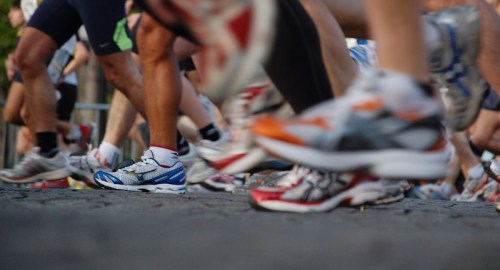
running feet


One example is our area is the Run United event on April 26, which consists of a 5K (5 kilometers or 3.1 miles), 10K (10 kilometers or 6.2 miles), a half marathon (13.1 miles), and a kids fun run. Almost everyone can participate in one of these events with some preparation, so it is a perfect event for the whole family.

If you are starting to walk for exercise, completing a 5K walk is a good goal. Start with a target of 20 minutes of walking per day. You can split this up into 10 minute segments, if necessary. After you are comfortable walking 20 minutes at a time, increase to 30 minutes per day. Continue increasing your walking time until you are up to 45-60 minutes per day, about how long it takes most people to walk three miles. If you already do some walking, gradually build up to this goal.

Maybe you already walk and are interested in trying running. Preparing for a 5K or 10K is great motivation. Start by adding some jogging into your walking routine. Try alternating 5 minutes of jogging with 10 minutes of walking. Once you are comfortable with that, try 5 minutes of jogging for every 5 minutes of walking. Increase the duration of the running intervals over time, until you can run for at least 30 minutes for a 5K or 60 minutes for a 10K consecutively. If running three or six miles is too much, you can always complete those races by alternating walking and running. Completing the half marathon will require more dedicated training, building up to running (or a run/walk combination) for over two hours.  To reduce the risk of injury you should progress slowly, whether you are walking or running. This is particularly important if you are building up to a longer event, like a 10K or half marathon.

Even if you don’t plan to participate in one of these events, the opportunity to get outdoors for a walk or run on a nice day is reason enough to be active. Use this as an opportunity to get your friends and family moving with you. Kids can ride their bike while you walk or run and you can push younger children in a stroller. Older children may want to walk or run with you, and don’t forget to bring your dog!


drparrsays blog footer

Start saving in your fitness bank for when you need it most.

Saving money for emergencies is good advice and important for maintaining quality of life in the event of a lost job or other financial crisis. While this may seem like common sense, many people have been caught without enough savings when they needed it and found it difficult to meet basic needs.

This principle can also be applied to fitness. When you are healthy, you can maintain a high level of fitness. This makes your day-to-day activities easier and serves as a reserve or “bank” to draw on when you need it. Your good fitness now can get you through a health crisis just like saving money can help you through a financial crisis. This health crisis could come in the form of an injury or illness that keeps you from being active for several days or a hospitalization that keeps you in bed for a week, a month, or longer. This is the topic of my Health & Fitness column in the Aiken Standard this week.

Patient walking in hospital


The problem with periods of inactivity, like bed rest or hospitalization, is that there are severe physiological effects that occur within days and get worse over time. You may have noticed this as weakness and fatigue after spending a few days in bed with a cold. Muscle strength declines with each day of bed rest, and can be 50% lower following as little as three weeks. That reduction in strength could limit a person who was already deconditioned to a point where he or she would have difficulty completing the most basic activities of daily living.

A person who was fit and strong when they went into the hospital would certainly be better off when released. And older adults fare worse than younger individuals. According to one study, the decline in strength seen in older men in just 10 days was equivalent to the change measured after 28 days in men 30 years younger.

It’s not just the muscles that are affected, the bones get weaker, too. In fact, 12 weeks of bed rest can reduce bone density by as much as 50%, exposing patients to a greater risk of fracture. This is due to the reduced stress on the bone from not standing and walking as well as the lack of muscle activity. Two of the most effective ways to build bone density are putting stress on bones through weight-bearing activity and the action of the muscles pulling on the bones from resistance training. Because bed rest eliminates both of these stresses, bone density declines rapidly.

One unique study from the 1960s had healthy young men complete three weeks of bed rest. They all experienced a rapid decline (over 20%) in their aerobic fitness, but recovered quickly after the experiment ended. These individuals also had their fitness tested again 30 years later. It turns out that the decline in fitness in those young men in three weeks of bed rest was greater than the decline in fitness that occurred over 30 years of aging!

The good news is that most patients are encouraged to move around as much as possible. Some receive in-patient physical therapy or rehab, even after major surgery, to help lessen the effects of prolonged bed rest. It is important to take advantage of these opportunities if you, or a loved one, are hospitalized.

There are many reasons to exercise and be fit, but an important reason may be to develop a fitness “bank” you can draw on if you become injured or hospitalized. Since the effects of bed rest are seen in people of all ages, everyone can benefit from a good fitness foundation. Just like putting money in the bank, doing a little now can have great benefits later when you need it most.

Finally, some smart advice: First, achieve and maintain a high level of fitness now, just as you would save money for a rainy day. You never know when you will need it. Second, if you are hospitalized, take advantage of opportunities to move, whether that is limited to moving from bed to a chair or if it includes short walks or even inpatient exercise–if the medical staff approves, of course. While many well-meaning friends and family members will tell you to rest and not move, true bed rest is almost the worse thing you can do.

For example, inpatient cardiac rehabilitation targets patients who are recovering from heart attacks and even open heart surgery. The goal is to get these patients up and moving as quickly as possible to prevent long-term consequences of bed rest.


drparrsays blog footer

Ever feel like the world is working against you. It’s our toxic activity environment

Recently I introduced the idea that we live in a “toxic environment,” which provides easy access to high-calorie, unhealthy, inexpensive food and promotes physical inactivity.  The focus was on the toxic food environment, so now it is time to explore our toxic activity environment which makes easy to be inactive and can discourage activity. This is the topic of my Health & Fitness column in the Aiken Standard this week.

No sidewalk

Continue reading

Today is the MLK Day of Service. Here’s how to be fit and ready to serve.

Today is Martin Luther King, Jr. Day, a time to celebrate the birthday and reflect on the accomplishments and legacy of Mr. King. It is also a  on which people are encouraged to use their day off from work and school to volunteer in their community. Individuals and groups across the country participate in community service, with some making this their first-time volunteer effort and many more continuing a year-round commitment to service.

You can maximize your impact in community service activities by being fit and healthy. To be sure, there are ways that people of physical abilities can contribute, but many service opportunities require a baseline level of fitness to participate. And it is certainly more enjoyable to volunteer if you aren’t being pushed to your limits. In fact, some service activities are similar in exertion to many forms of exercise and some may be consistent with maximal exercise. Unfortunately, the common pattern of inactivity and obesity can limit people’s ability to function optimally at school, work, or in leisure-time activities, including community service.This is the topic of my Health & Fitness column in the Aiken Standard this week.

Photo by tear cordez from Pexels

Continue reading

We live in a toxic food environment. Here are some tips to help you survive.

The term “toxic environment” was popularized years ago to refer to conditions that promote the consumption of high-calorie, unhealthy food and encourage being physically inactive. This combination is thought to be a major factor that contributes to obesity and other chronic diseases, so understanding both aspects is important. For now, lets focus on our toxic food environment, which I do in my Health & Fitness column in the Aiken Standard this week.

Soda aisle

Continue reading