Good news for coffee drinkers!

If you drink coffee you have probably heard that drinking coffee is bad for your health from your non-coffee drinking friends and colleagues. They probably couldn’t say why, but they may have mentioned the caffeine, or the fact that coffee is brown, or some other reason. The fact of the matter is that there was no good evidence that drinking coffee is associated with negative health outcomes. Nor was there a consensus that coffee has health benefits. Until now.

In a study published this week in the New England Journal of Medicine, coffee consumption was associated with a lower risk of death from heart disease, respiratory disease, stroke, and diabetes in over 400,000 men and women followed for 14 years.

The New York Times Well blog has a nice summary of this study. Read it while you enjoy a cup of coffee. 

America’s fattest cat has died from obesity-related complications

USA Today: Cat Meow dies of obesity complications

Imagine that! I wonder if people can die from obesity, too? Or is it just cats?

Exercise is Medicine

May is Exercise is Medicine month, so the topic for my Health & Fitness column in the Aiken Standard this week is information about the Exercise is Medicine initiative. A growing body of research suggests that the single best prescription any physician can give is for daily physical activity. But many (or most) physicians either do not make this recommendation or, if they do, do not provide the information or resources that patients need to embark on a program of regular activity. I will probably write about why this is the case — it’s not always the fault of the physician — and what can be done about it in a future column.

You can learn more about the Exercise is Medicine initiative here.

The best medicine

In my Aiken Standard Health & Fitness column last week I wrote about recent research that supports the use of obesity surgery, specifically gastric bypass surgery, for treating diabetes and other chronic conditions. It turns out that the surgery has beneficial health effects beyond weight loss. For some people, gastric bypass surgery may a reasonable option, especially if they have serious health conditions.

In my column this week I explain that surgery is not the only option and shouldn’t be the first choice for treatment. Since for almost everyone obesity is a lifestyle disease, it should be treated with lifestyle modification. Even if surgery is used, changing diet and activity habits is essential for maintaining weight loss. You can apply the same logic to medications used to control cholesterol and blood pressure. In most cases, diet and exercise would be sufficient on their own. But even if a drug is used, lifestyle modification is still an important part of the treatment. This is especially true considering the potentially serious side effects of many medications. Recent research suggests that some commonly used drugs to lower cholesterol (statins) can cause muscle damage and cognitive impairment.

Diet and exercise really are the best medicine!

A new way of looking at what we eat

This is a really cool visualization of the “healthiness” of food people eat over a 24 hour time period. This visualization is based on data collected from over 7 million people over five months who track what they eat using an iPhone all called Eatery. Users upload a photo of their food and it is rated by others. While the people doing the rating aren’t nutrition experts, the results are still useful. This is a concept called crowd sourcing. It turns out that feedback from multiple non-experts can approximate what you would learn from one expert. In a sense, the crowd becomes the expert. Consider the jelly bean example: one of the most accurate ways to guess the number of jellybeans in a jar is to average the guesses of everyone in the room.

Back to the visualization…Notice that people tend to eat less healthy food at night. While much of this has to do with choices we make when we are up late, it may also reflect food availability. This has implications for people who work at night. Think about the types of restaurants and stores that are open all night compared to during the day. The link between night shift work, poor diet, and health consequences was explored in an editorial in the journal PLoS Medicine.

Also take a look at the other elegant infographics on the  Massive Health website. They are a compelling way of presenting data about what we eat.

A cure for diabetes?

I spend much of my time talking about the benefits of a healthy diet and regular exercise to anyone who will listen–and to some people who won’t. I usually include something about the fact that, for many conditions, lifestyle change is at least as effective as medical management, certainly for preventing diseases like diabetes, hypertension, and dyslipidemia. So it was with some reluctance that I jumped on the bandwagon with a growing number of surgeons who believe that bariatric (weight loss) surgery is an effective treatment for diabetes.  This was the topic of my Health & Fitness column in today’s Aiken Standard.

Let me be clear: This doesn’t mean that diet and exercise don’t work. In fact, successful long-term weight loss requires dietary modification and daily exercise, regardless of how the weight was lost. Ideally, diet and exercise would be the method that everyone uses to lose weight–it works, but only if people a faithful to the treatment. Unfortunately, most people are not, leading to the belief that diet and exercise don’t work. And for some who are extremely obese, it is unlikely that diet and exercise could produce results sufficient enough and quickly enough to treat serious health problems (including diabetes) that are likely in progress. For this reason, many turn to weight loss surgery for a quick fix.

For years I was skeptical, but a growing body of literature, including two recent studies in the New England Journal of Medicine, suggest that obesity surgery can “cure”diabetes. [you can read these studies here and here] The results of these studies show short term benefits, so it is unknown whether this is a permanent cure or not.

Either way, diet and exercise are necessary to maintain the weight loss in the long run as well as treating other health conditions. And a healthy diet, regular exercise, and maintaining a healthy body weight are  still the only ways to prevent diabetes. The bottom line is that the true benefits of weight loss surgery cannot be realized without lifestyle change. And if you adopted a healthy lifestyle from the beginning, you wouldn’t need to even consider obesity surgery.

If you are the podcast type, there is an excellent description of these recent studies as well as a discussion of the risks and benefits of obesity surgery from NPR’s Talk of the Nation.

Good for the Earth and Your Health

Earth Day is Sunday, April 22. While the focus is on protecting our natural environment, there are several things you can do that benefit your health, too.

Good for the Earth and health | Aiken Standard.

The K-E diet: I suppose I shouldn’t be surprised, but…

This is wrong on so many levels!

The K-E Diet: Brides-to-Be Using Feeding Tubes to Rapidly Shed Pounds


Just do it!

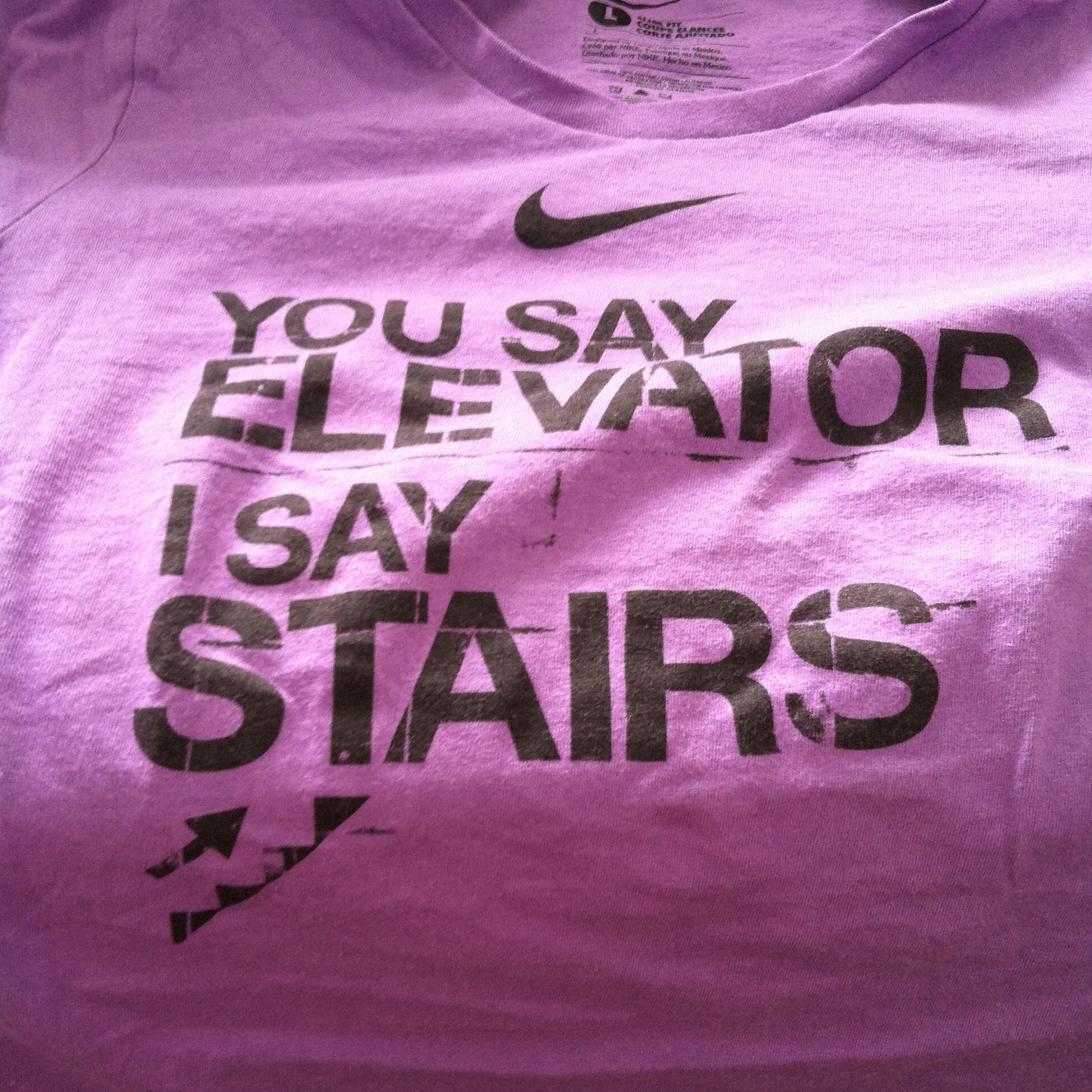
It looks like Nike, having conquered the world of sports, has moved on to the world of incidental physical activity.

I expect that Gatorade will be developing a sports drink specific for stair climbing in the near future.

Achoo! Exercise and seasonal allergies

Is it okay to exercise if you have seasonal allergies? Will exercise reduce your allergy symptoms or make them worse? Read more in my Health & Fitness column in the Aiken Standard.