In vitro beef and other fake food.

My Health & Fitness column in the Aiken Standard this week is about the in vitro burger you no doubt heard about in the news. Would you eat meat that was created in a laboratory? Many people would say no, mostly because it seems “unnatural.”

But most of us eat plenty of processed and modified foods every day. Aren’t these foods also unnatural?

You can learn more about the story behind the creation as well as results of the first taste test of the “test tube” burger at the following links:

A good New York Times story about the taste test here.

An article in Scientific American here:

If you are looking for something to listen to while you exercise, try this radio story on Science Friday on NPR.

Another New York Times story about the creation of the burger is here.

What kids will be missing when they go back to school.

My Health & Fitness column in the Aiken Standard this week is about the experience of heading back to school. But it’s really about what most kids won’t experience when they are in school—any meaningful education about nutrition, activity, and health.

To be sure, the time that students spend learning the math and science, reading and writing, and art and music is time well spent. Unfortunately, though, in most schools, this comes at the expense of health education. In fact, opportunities for children to be active in school, either through formal physical education or more informal play and recess, has declined over the years. Good nutrition isn’t likely to get much classroom time at any level and the food served in most school hardly sends a positive message about healthy eating. These are missed opportunities!

This isn’t new, of course. I have written about the both the importance of physical activity for growth and learning for children (and adults, too) and the impact of these missed opportunities before. And I’m certainly not the only one to take notice. Probably the most widely known advocate in this area is Jamie Oliver, and his efforts made nutrition and health in schools topics for discussion among parents, teachers, administrators, and politicians alike.

Exercise now can help you pass your vacation fitness test.

There are loads of good reasons to sit less, move more, and get regular exercise. But beyond the health and fitness benefits, regular physical activity can help you enjoy your next vacation even more. This is the topic of my Health & Fitness column in the Aiken Standard this week.

Since most vacations involve activity during sightseeing, visiting a theme park, or other pursuits, it can be a challenge to people who spend much of their time being sedentary. A long day (or two or three) at Disney World is actually a pretty good fitness test. And being active in your non-vacation life can help you fare better.

In the column I cited a study that shows that people feel better following an active vacation. You can read that study here.

Sports physiology in the Tour de France: It’s not just about doping!

My Health & Fitness column in the Aiken Standard this week is about the physiology of endurance exercise, using the Tour de France cycling race as an example. While much of the news surrounding this event has to do with the use of performance-enhancing agents, it is important to acknowledge the underlying physiology, training, and nutrition that makes it possible for athletes to perform at such a high level, with or without doping.

You learn pretty much everything there is to know about the race this year at the official Tour de France website.

The Discovery Channel made an excellent documentary about the science of cycling, featuring (pre-doping scandal) Lance Armstrong. Even though Armstrong is the focus of the show, the science applies to all elite cyclists. In fact, the show is an excellent teaching tool about the relationship between physiology, training, and equipment that is critical for performance in many sports. You can watch it on YouTube here.

Speaking of the science of Lance Armstrong… Back in 2005, Ed Coyle, Ph.D., an Exercise Physiologist at the University of Texas Austin, published a paper based on laboratory testing in the Journal of Applied Physiology about Armstrong and the physiological and biomechanical factors that may have contributed to his seven consecutive Tour de France victories.

Since Armstrong recently admitted to using a combination of performance-enhancing agents during that time, it is possible that doping and not the improved efficiency measured in the lab was responsible for his success. Coyle addressed this issue in a recent editorial in the same journal.

Go for a swim!

It’s summer and it’s hot, so it seems like a good time to write about the health and fitness benefits of swimming. Which is exactly what I did in my Health & Fitness column in the Aiken Standard this week.

Swimming is a great way to get in shape, build muscle, and to help you lose (and maintain) weight. Lap swimming is is about as aerobically demanding and burns as many calories as land-based exercise such as walking or jogging. (Obviously, it depends on the stroke you use and how fast you swim).

Since water is more dense than air, aquatic exercise is lower impact that exercise on land. This means that water aerobics, aqua walking or jogging, and resistance training using foam “weights” or webbed gloves can be done by people with conditions such as arthritis or for injury rehabilitation.

Even swimming leisurely or playing in a pool or lake can burn a substantial number of calories, so it is a healthy way to beat the sumer heat.

If you are interested in using your pool for exercise, you can find information about aquatic exercise in general here and links to suggested exercises here. You can learn more about aquatic exercise specifically for arthritis and fibromyalgia, too.


Apparently, this is for real: Shaq Soda. Also for real: It’s not healthy.

So, Shaq has a new soda. I’m sure you won’t be surprised to learn that it has been criticized for both the flavor and the fact that it is loaded with sugar (each can contains 72 grams, equivalent to 17 teaspoons), just what we want a “role model” promoting to our kids. This is a departure from his previous efforts to reduce obesity among children.

I bet he got paid more for the soda.


The best answer I have seen to questions about dietary supplements

I get a lot of questions about nutritional supplements. Should I take (fill in the blank)? Will it help me lose weight? What would I recommend? Most of the time, my answers are disappointing.

Since there is very little research to support big benefits of taking supplements, I tend to respond with something like this: “There is no good reason* why you should take supplements so it probably won’t help much. I  probably won’t hurt you either, so if you have the extra money, go ahead.”

*Unless your physician tells you to. And tell your physician about supplements you do take.

I recently read a much better response. It’s from Marion Nestle, a professor, writer, and all-around expert about all things nutrition. It’s from a Q&A on her blog, Food Politics. You should make it part of your regular reading.

Q: Why are you so hard on nutritional supplements? You must be one of those people who thinks they kill people.

A: Don’t get me wrong. Nutrient supplements are great for people who have nutrient deficiencies. Whether they make people worse is arguable, but study after study shows that nutrient supplements do not make healthy people healthier. If you like to take supplements, I’m guessing you don’t care much about what the science says. Supplements aren’t about evidence-based medicine. They are about deep distrust of modern diets, science and the health care system. If nothing else, supplements are powerful placebos, and I’m not at all convinced they are seriously harmful. My advice: Supplements, like everything else about nutrition, should be taken in moderation.

Good, right? Why didn’t I think of that?

Food science beach reads: learn about food and cooking while you work on your tan

My Health & Fitness column in the Aiken Standard this week is a summer reading list of books about food  and cooking. It turns out that most people really don’t understand what they are eating or the processes that went into cooking their food. Knowing how food is prepared can help you make healthier eating choices, whether you are doing the cooking yourself or if you are eating prepared meals.

Here are three books about food science you can take to the beach (and one you can’t):

Cooked: A Natural History of Transformation by Michael Pollan

This is the most recent of Pollan’s excellent books, all of which should be required reading for anyone who eats. You can hear a nice interview with him about Cooked here and one about a previous book here (both are from Science Friday on NPR).

On Food and Cooking: The Science and Lore of the Kitchen by Harold McGee

Harold McGee also contributed to an excellent series about coffee on Science Friday on NPR. It turns out we can learn a few things about the first thing many of us consume each day.

McGee also has/had a column in the New York Times called the Curious Cook. It doesn’t appear to have been updated recently, but the older posts are still worth a read.

What Einstein Told His Cook: Kitchen Science Explained and What Einstein Told His Cook 2, The Sequel: Further Adventures in Kitchen Science by Robert Wolke

Robert Wolke also used to write a column called Food 101 in the Washington Post. The old articles are still available and worth checking out.

Modernist Cuisine: The Art and Science of Cooking by Nathan Myhrvold

This one is a workout both to read (it is a collection of six books) and to carry to the beach (it weighs over 50 lbs)! Even if you don’t buy it (it costs over $500) it is worth a look—the pictures of the cooking processes are amazing. In fact, a book of photos called The Photography of Modernist Cuisine is available for pre-order now.

My son, the Michigan State Police, and healthy choices at McDonald’s

Earlier this evening my family went for a bike ride. That’s when my son got pulled over by the Michigan State Police and was given a ticket!

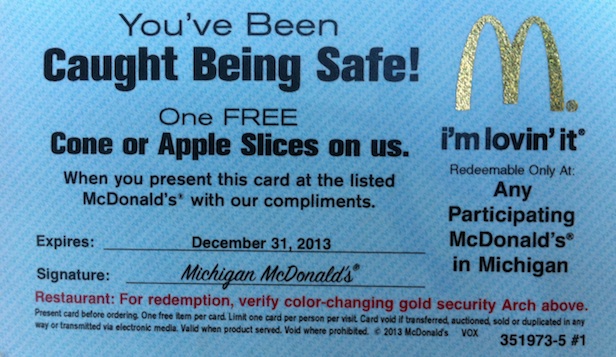
He was pulled over for being safe by wearing a helmet and the “ticket” was a card for a free ice cream cone at McDonald’s.

It is part of a program that rewards kids for being safe and wearing a helmet when they ride a bike. Since we were all wearing helmets, my oldest son (and his two younger brothers) got “tickets” from the police officer.

It was when we got home and I looked at the card more closely that I noticed something nice—the card is good for either a free ice cream cone OR apple slices.

icecream_or_apples Bike_helmet

I’m sure almost all kids will pick the cone (I know my kids will!), but it’s nice to have a healthy option.

Go for a walk when you fly. Ideas for staying active when you travel.

I typically don’t travel much, but I have been on several trips in the past month or so. Since I’m a bit of an activity geek, I have been noticing the opportunities for and barriers to activity that are present when traveling by air. For the most part, flying involves a lot of sitting—on the plane and in the airport waiting for flights. But it doesn’t need to be this way.

Staying active when you travel is the topic of my Health & Fitness column in the Aiken Standard this week. Of course, I’m not the only one who tries to move more when I fly, both on the plane and in the airport. For example, this guy takes being active between flights to a whole new level. (Yes, he is my hero.)

While it is possible to use your time in the airport to be active, it isn’t always the first thing you think of. Even though nearly everyone does some walking in the airport, moving walkways and trains are an easy alternative to walking the sometimes long distances between terminals. Some airports are better than others at encouraging active transportation in the airport.

For example, the Hartsfield-Jackson airport in Atlanta has a train that runs between the terminals. Right next to the train is a walkway that also connects the terminals. There are signs that tell you how far you have to go (it’s a little less than 1/4 mile between terminals) and art, history, and local information displays line the walkway. Other airports do this too, and some have elaborate light and music shows to keep you entertained. Others have dedicated spaces for exercise, like the yoga room in the San Francisco airport.

Not every airport has made this level of effort to help travelers be more active, but this should change in the future. The American College of Sports Medicine has a Healthy Air Travel task force that aims to develop more opportunities for activity in airports by providing information and other resources to airport management and travelers.

You should also try to be active during your flight, too. Getting up out of your seat (when allowed, of course) or doing simple foot and leg exercises is a good idea. This is recommended to reduce the risk of blood clots that could develop during prolonged sitting. Even though the risk of these blood clots, commonly called “economy class syndrome,” may be low, moving around during a flight is still a good idea.

Between limiting prolonged sitting during the flight and walking more in the airport, my guess is that some people probably get more activity on days when they fly!

Of course, there is another whole aspect of healthy travel that I haven’t addressed: making smart decisions about what to eat for meals and snacks. But that is a story for another time…