Know your nutrients: Fats

I am continuing my celebration of  National Nutrition Month by writing about the major nutrients (called “macronutrients”) in my Health & Fitness column in the Aiken Standard. This week I provided information about fats.

Although there are different sources and types of dietary fats, they are are usually grouped together. This leads to the misperception that “fat is bad” or “fat is good. It turns out that some fat intake is essential for good health and getting more of your dietary fats from some sources is better for your health than other sources. For example, saturated fat and trans fats are This is where things get confusing.

I try to alleviate some of this confusion in my column, but I wanted to provide some links to additional (and quality) information. You can learn more about dietary fats, including additional details about functions, health effects, and recommendations from the Centers for Disease Control and Prevention here and from the Mayo Clinic here.

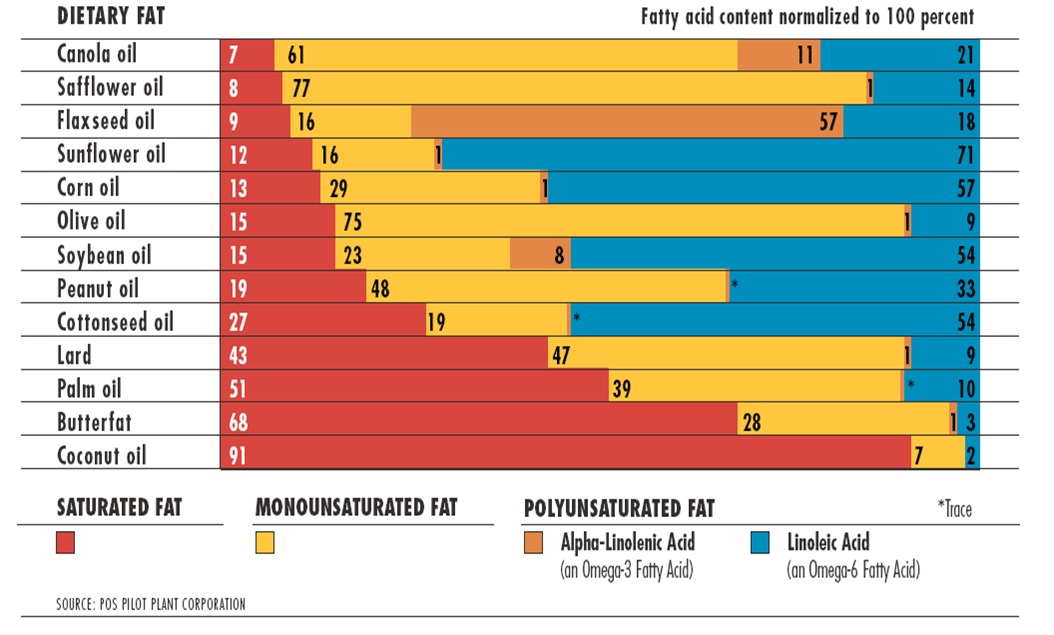
Ultimately, making smart food choices is needed to shift the balance from unhealthy (saturated and trans) fats to healthier (monounsaturated and omega-3) fats. But determining the types of fats in the food we eat is difficult, to say the least. This excellent graphic shows the food sources of the various types of fatty acids and I find it helpful for making recommendations.
Image

Source: http://canola.okstate.edu/nutrition

Even though the health effects of dietary fats is a confusing issue, the bottom line is that most people could benefit from the following two steps:

  1. Reducing their intake of total fat
  2. Shifting the balance  away from saturated (primarily animal sources) and trans (processed foods) fats toward monounsaturated and omega-3 fats from vegetable oils and fish.
Know your nutrients: Carbohydrates

March is National Nutrition Month, an annual campaign to educate people about making healthy eating choices. Reading food labels is an important step in making smart choices. But food labels tend to be confusing, and many people don’t understand the terminology or even what the major nutrients listed on a food label are. In order to make informed decisions, people really need to know some basic information about the food we eat, including the major nutrients.

I am celebrating National Nutrition Month by writing about the major nutrients—carbohydrates, fats, and protein—in my Health & Fitness column in the Aiken Standard. This week I provide an introduction to carbohydrates.

You can learn more about carbohydrates, including specific guidelines and recommendations here.  I recently heard an interesting segment about whole grains on the NPR show Talk of the Nation. Apparently, all whole grains are not created equally. It’s worth a listen.

This has nothing to do with exercise or fitness or nutrition, but it is interesting!

So, I’m a bit of an NPR geek and Talk of the Nation Science Friday is often the most interesting part of my week. Unfortunately, I usually miss the live radio shows so I end up listen to the podcasts.

Aside: This adds to my geek cred when a student asks what I am listening to when I am on the treadmill in the gym!

I fell a few  weeks behind, so I was getting caught up when I heard this segment called “Ask a Dentist.” It has nothing to do with nutrition or exercise or fitness, but it was SO INTERESTING! It answered several questions I had about my teeth and a few more questions I didn’t know I had. Do yourself, and your teeth, a favor and check it out here.

If you were paid millions of dollars, you would lose weight too!

Jared Fogle has been a spokesperson for Subway restaurants for 15 years now. He has had a huge impact on Subway sales, largely because of his remarkable weight loss which was due, in part, to eating Subway sandwiches. (Of course, there is nothing magical about his “Subway diet.” The weight loss was due to the fact that he was eating far fewer calories!)

What is more remarkable than his initial weight loss is the fact that Jared kept the weight off for 15 years. He has had some serious motivation to do so. First, he has literally been paid millions of dollars to keep the weight off. Second, because his story is so widely known and because he is so recognizable, Jared is accountable to all of us. His weight regain would be noticed by many people, include some who have made him a role model.

Most of us won’t get paid to lose weight (or exercise or quit smoking), but we can find something to motivate us. And by telling people about our goals—or better yet, getting them involved with us—we are accountable to others. In this way we can benefit from the very same factors that have contributed to Jared’s success.

You can read more about motivation and accountability and making health behavior changes in my Health & Fitness column in the Aiken Standard this week.

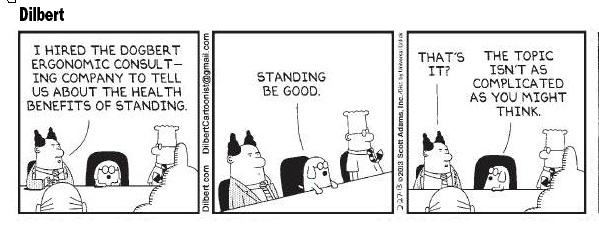
Health advice so simple it can be explained in a Dilbert cartoon.

Sit less, stand more. I guess it is pretty simple.

Sit less Dilbert

A healthy body weight is in your genes!

Earlier this month I was at the annual meeting for the Southeast chapter of the American College of Sports Medicine. The keynote address was by a genetic researcher, Dr. Molly Bray, who spoke about the role of genes in health behaviors. While heredity has been linked to body composition (muscularity, body fatness) for some time, the idea that genes can influence health behaviors such as eating and physical activity habits is somewhat new.

I thought this was interesting and a good way to explain individual differences and family similarities in diet, exercise, and obesity so it is the topic of my Health & Fitness column in the Aiken Standard this week. Many people, including many of my colleagues, are uncomfortable with the idea that genetics plays a role in health behaviors. This idea calls into question our traditional belief that people who obese, unfit, or eat poorly simply lack the motivation or willpower that people who maintain a healthy body weight and who eat a healthy diet have. It seems that genes explain at least a portion of these differences.

Does this mean that we are not responsible for our health?  Absolutely not! While genes may influence our appetite, food preferences, physical activity level, and responses to diets and exercise, ultimately we are in control of what we eat and how active we are. But knowing the role of genes in health can help us understand why some people struggle more than others to adopt healthy behaviors. It also helps explain why some people fare better than others in our obesogenic environment.

In my column I mentioned the Heritage Family Study which examined the genetic factors associated with body fatness, fitness, and other health factors. You can learn more about this important study here. I also cited a recent study that reported the discovery of two genes that regulate appetite. You can read a low-science article about that study here or read the hi-sci paper in the American Journal of Clinical Nutrition here.

Too much of a good thing–can you do too much exercise?

Given that most people aren’t active enough, the message “move more” seems like a good one. But it is possible to do too much. my Health & Fitness column in the Aiken Standard this week discusses the potential hazards of doing too much exercise as well as how to avoid this situation.

For most people, the biggest risk for doing too much comes when they begin an exercise program. Progressing too quickly to longer time and/or higher intensity exercise can lead to muscle soreness or injury. A common guideline is the 10% rule: don’t increase your time or intensity more than 10% at a time. Although increases of 10% may not always be practical—a 10% increase from a 30 minute jog is 33 minutes—the message to increase slowly is a good one. Incidentally, this New York Times article suggests that there isn’t any good evidence that following the 10% rule reduces injury risk. That said, going from a 30 minute run to 60 minutes is too much, too soon.

One way to get guidance on how to progress in an exercise program is to consult a fitness professional, like a personal trainer. Sadly, many people get injured, or at least have a bad exercise experience, because of an overly ambitious personal trainer. Make sure you find someone who has experience with novice exercisers to help reduce this risk.

Despite the potential hazards of doing too much exercise, most people should worry about not doing enough. So, get moving!

Simplifying calorie calculations for weight loss

Setting realistic weight loss goals and determining how many calories you should include in your diet requires estimating how many calories you eat and how many you burn each day. Sometimes these calculations can get a bit tedious.

The website Lifehacker just posted an article simplifying these calculations. Their approach is useful because a rough estimate of calories is enough to guide your eating and exercise habits. There really is no practical need for more precise calculations.

I would add one more number to know: 100. Walking or running one mile burns approximately 100 calories. The exact number depends on several factors including body weight and speed, but using 100 calories per mile makes calculations simple. For example, how many miles will you have to walk to burn off the the double mocha latte you had this morning?

By the way, Lifehacker regularly publishes articles on exercise and nutrition. I like the way they simplify sometimes complicated concepts and come up with practical solutions to common problems. From what I have seen, their interpretation and advice is consistent with the science, too.

There are no shortcuts—you actually have to exercise to get the benefits of exercise.

There are many people who would be thrilled to find a way to get the benefits of exercise without having to be active. Unfortunately, the only way to get the health and fitness benefits of exercise is to actually exercise. But there are some ways you can minimize the time you need to spend to get these benefits. You can learn more about this in my Health & Fitness column in the Aiken Standard this week.

In my column I wrote about the popular “10 minute” exercise routines that can promote strength and endurance gains that are greater than some longer-duration exercise programs. I have written about the advantages and disadvantages of these short, intense workouts previously.

I also included a bit on spot reduction, the claim that you can burn fat from a certain area of the body by exercising just that part. Abdominal exercises are often thought to burn fat from your midsection and a variety of exercise devices are based on this claim. Unfortunately, spot reduction doesn’t work. Here’s proof: If spot reduction did work, you would never see people with chubby cheeks chewing gum!

I also mentioned research into an exercise pill—a drug that would mimic the muscular adaptations to exercise. While there is great interest in this type of drug to treat certain muscle disorders as well as to eliminate the need for exercise, it doesn’t exist at this time. You can read more about this research here and here.

Work out, or no TV for you!

I have thought for a long time that a good way to get people to be more active is to prevent them from watching TV or even getting in their house at the end of the day if they haven’t exercised. Maybe the door wouldn’t unlock if their pedometer didn’t show at least 10,000 steps. Totally unreasonable, I know.

Or is it…

Lifehacker featured an article yesterday about how to rig up a system that cuts the power to your TV (or anything else you want) if you haven’t met your activity goals. It utilizes the FitBit activity tracker and the Belkin WeMo internet-controlled power outlet and requires some effort to set up, but it seems like it would be effective.